Gene A’Hern’s works are vivid, textural, and resonate with dynamic movement. His practice resonates strongly with the role of spirituality in art, and the power of quiet, process-driven work
A man of few words, he lets the works do most of the talking. At Melbourne Art Fair, Cassandra Bird presents a solo exhibition of work by A’Hern. This new body of work, created specifically for the Fair, will mark a significant evolution in A’hern’s practice, expanding his distinctive visual language through layered mark-making, symbolic abstraction, and a meditative use of colour and space. Find them at Melbourne Art Fair, Booth B3.
What does drawing allow you to access that other processes don’t?
Drawing allows an immediacy in communicating and problem solving. I am also able to flow through impulse and intuition more easily.
Natural elements consistently appear in your work. Paired with texture, they oscillate between abstraction and clear representation. Are these motifs instinctively brought to the work? How does tactility function in conveying place, emotion, or time?
I incorporate mountain peaks, rain, sky and bushland throughout my work instinctively and from memory. Nature is huge part of my every day life as well as my experience growing up. I am constantly observing and processing the natural environment around me.
I find that texture can amplify a tension and release within a painting, often contributing to harmony which I have previously mentioned is a key component of a finished piece for me.
There’s a strong sense of dynamic movement in your work. How conscious are you of spatial dynamics while working, and how much emerges intuitively?
I am and I’m not at the same time. I am mostly an intuitive painter but sometimes I have more of plan. It is most natural for me to paint with dynamic movement because the physicality and rhythm of painting is the ‘flow state’ for me, and it tends to manifest on the canvas in those spatial dynamics.
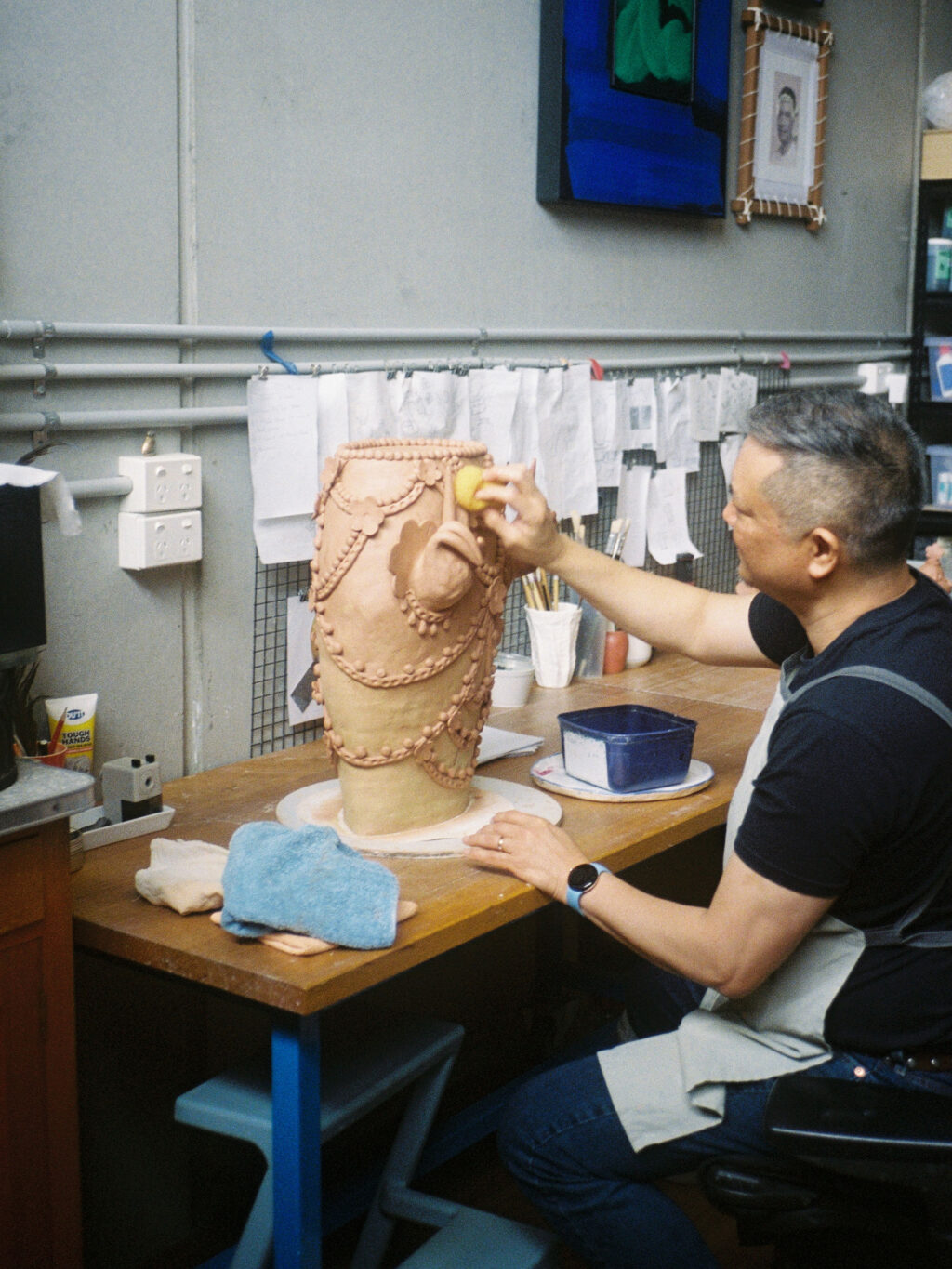
Gene A’Hern in studio. Courtesy the artist and Cassandra Bird Gallery.
You’ve previously spoken about your love for hiking. What are your favourite spots?
One of my favourite spots is Cradle mountain in Tasmania, but I am lucky to live in the Blue Mountains where there are countless beautiful hikes nearby.
Do you have any specific rituals or routines to get you in the right headspace for working?
Not really, I just have a coffee.
Are there any mistakes you have made while working that end up adding to a piece in a way you didn’t expect?
There are constantly shifts in colour, tones and form as I paint. ‘Mistakes’ often lead to new discovery, and I have learnt to accept them as being a genuine part of the process.
For curator and MAF ambassador, Sebastian Goldspink, Melbourne Art Fair is a chance to reconnect with friends, colleagues and the wider arts community from across the continent and beyond. It’s a snapshot of contemporary practice and the new and exciting work shaping the field today.
You can also discover your favourite artists with him at the Fair through his Young Galleries and Practical Pathways tours, designed to spotlight emerging voices and offer behind-the-scenes insight.
We asked him to share a few of his highlights ahead of the Fair next week.
ALEX SETON
SULLIVAN & STRUMPF BOOTH F5
I’m especially excited to see Alex Seton’s new work with Sullivan & Strumpf. Created using Portuguese marble sourced during his recent residency, these works continue Seton’s remarkable command of material and form. Few artists handle stone with such precision and sensitivity. A true master of the medium.
Alex Setton, The Tenderness Series, 2025. Photography By Camilla Santitni
MARK WHALEN
1301SW/STARKWHITE BOOTH A2
1301SW is showcasing so many great artists at the Fair this year. I’m really looking forward to seeing Mark Whalen’s incredible sculptures juxtaposed with paintings by Simone Griffin, Anselm Reyle and more. Mark is an Australian based in Los Angeles who’s taking on the world.
Mark Whalen, Night lights, 2025. Oil on aluminium, bronze, copper, and glass. 50.80 x 38.10 x 30.50 cm. Courtesy of the artist and 1301SW/STARKWHITE
JARRA KARALINAR STEEL
GAMMIN THREADS BOOTH C6
I’m looking forward to Jarra Karalinar Steel’s collaboration with Gammin Threads as part of the Victorian First Peoples presentation. They will be showcasing their iilk collection – Gammin Threads never misses on presence.
A must-see in the CONVERSATIONS Program, Jack Wilkie-Jans will speak with Jarra on her unique and distinctive multi-disciplinary practice, and the ways Boonwurrung culture, Country and histories inform her work.
Courtesy Gammin Threads. Photo: Emily Seif.
CÉCILE B. EVANS
CHÂTEAU SHATTO VIDEO
Château Shatto is a gallery from Los Angeles that I follow closely. It’s great to see international galleries at MAF. I’m really looking forward to seeing Reality or Not, the Belgium/American artist Cécile B. Evans video work, exploring the forces that shape reality.
Cécile B. Evans, Reality or Not (Still), 2023. HD Video, 34 min and 53 sec.
PALAS BOOTH B1
PALAS is a gallery that consistently delivers, and this year’s presentation is no exception. Bringing together artists including Marco Fusinato, Nick Collerson and Shaun Gladwell, the booth promises a compelling invitation for conversation.
Nick Collerson, (left) Deer Moon, 2025, oil on canvas, 137.2 x 152.5 cm. (right) Together, 2025, oil on canvas, 71.5 x 91.5 cm. Photo: Josh Raymond. Courtesy of the Artist & PALAS, Sydney
AMES YAVUZ BOOTH A1
At Ames Yavuz I’m thrilled to see an incredible pairing of Caroline Rothwell and the late-great Rosemary Laing. Laing’s vivid photographs are both incredibly beautiful yet somehow unsettling – depicting the the intrusion of human systems into living environments.
Rosemary Laing, Groundspeed (Rose Petal) #17, 2001, Type C photograph.
STATION BOOTH H8
Tom Polo’s presentation with Station is a highlight for me. His paintings are unmistakable. They are gestural, luminous, and full of energy. To see his work alongside legend Gareth Sansom and Marian Tubbs makes for a particularly dynamic encounter.
Tom Polo, doubt and departure (blue bodies), acrylic and oil stick on canvas 182 x 138 cm.
Sebastian Goldspink is an independent curator based in Sydney, renowned for his commitment to fostering emerging artistic talent. In 2011, he founded ALASKA Projects—a dynamic exhibition space dedicated to supporting early-career artists, curators, and writers through a diverse program of local, national, and international projects.
Goldspink has held key professional roles with leading institutions including the Museum of Contemporary Art, Art Month Sydney, and the National Art School. He also served as Director of regional galleries for both Woollahra and Sutherland Shire Councils.
A proud Burramattagal man, Goldspink is deeply engaged in shaping the future of Australian art. He sits on the board of the Power Institute at the University of Sydney and Western Sydney Creative at Western Sydney University, championing inclusive and innovative approaches to arts education and practice.
Melbourne Art Fair, 19 – 22 February 2026 at the Melbourne Convention and Exhibition Centre.
Veteran of the Kiln, Vipoo Srivilasa On Creating Works That Radiate Joy
Vipoo Srivilasa has been in the ceramics game for years. Now a veteran of the kiln, the Thai-born Australian artist creates work that radiates joy.
His major exhibition, re/Joy, is currently touring the country, and is the largest body of work he has ever attempted. He chats with us at Melbourne Art Fair about the ideas behind the exhibition, the patience that ceramics demands, and his new Fortune Teller Deities for Melbourne Art Fair 2026.
Presented by Föenander Galleries, his work will feature alongside fellow artists Lottie Consalvo and Harry McAlpine.
How did you begin working in ceramics?
My first experience with ceramics was at the College of Fine Arts in Thailand. At the time, I was making fashion accessories such as necklaces and earrings using air-dry clay. The work became very popular, which made me a nice pocket money. That experience led me to choose ceramics as my major subject for both my graduate and master’s degrees.
I love the touch of clay, it’s very tactile and, I think, quite sexy. I enjoy the transformation of a simple lump of clay into something expressive and full of character. Clay works naturally with my hands; somehow they just seem to know what to do. I’m also drawn to how versatile the material is, and to the excitement of opening a kiln. You never fully know what a piece will look like until it comes out.
Ceramics can be unpredictable in the kiln. Have any accidents or ‘failures’ ended up shaping the final work?
There are always accidents in ceramics. Sometimes they are happy accidents, but most of the time they are not. I try to see these moments as part of the learning process. Each mistake teaches me what not to do next time, so I don’t really think of them as failures.
That said, it can be difficult to stay positive when time is tight or a work has taken weeks to make. Ceramics demands patience and acceptance. Over time, I’ve learned that these unpredictable moments are part of what gives the medium its life and honesty.
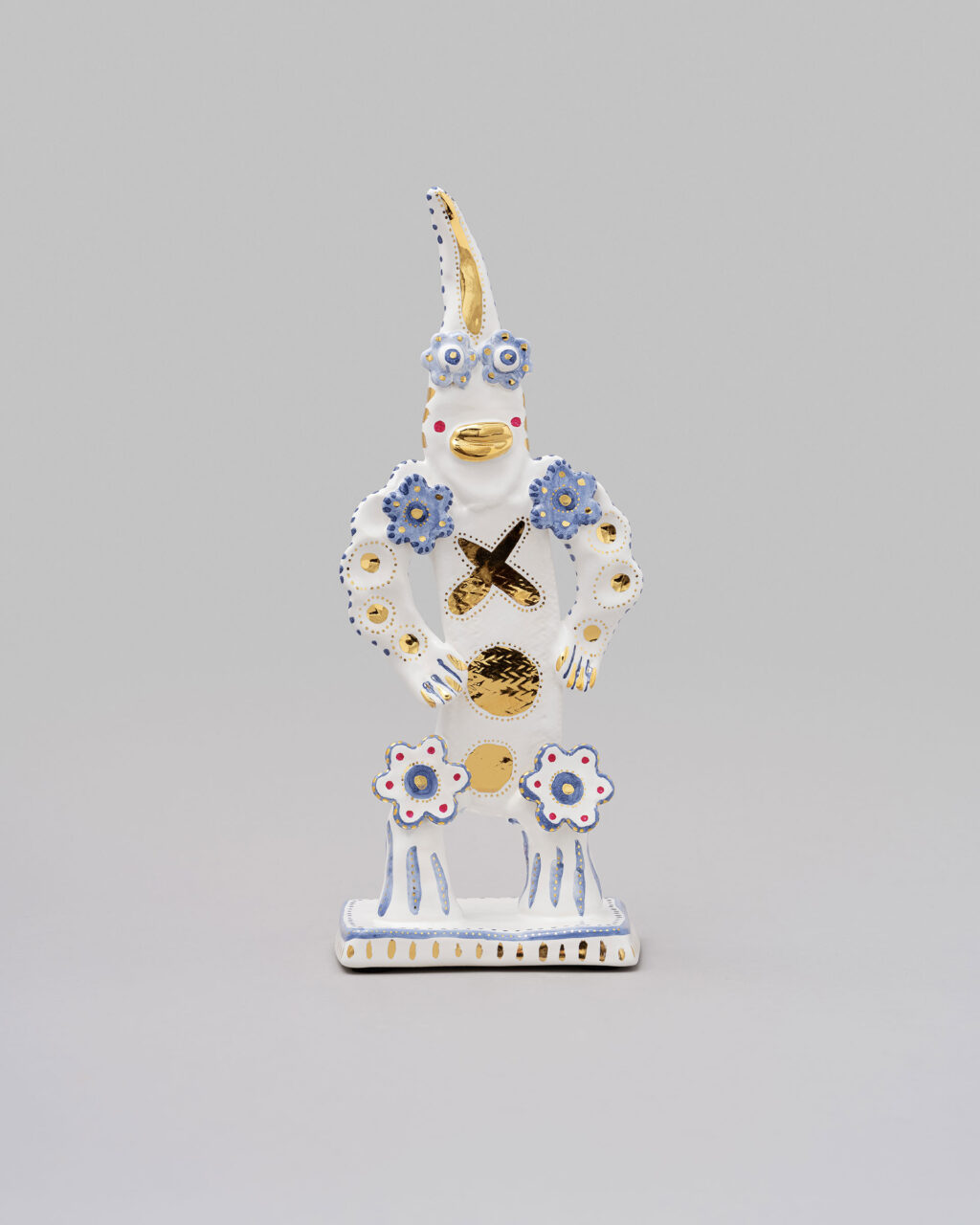
Vipoo Srivilasa, The Wish Listener, 2026, Glazed earthenware with gold lustre and synthetic polymer paint. 290 x 120 x 90mm.
Your exhibition, re/JOY, currently touring Australia, incorporates broken pieces from objects of personal significance. Can you expand on a couple of the objects you were donated and the stories behind them?
The objects donated for re/JOY came with very personal stories—items that were broken but still deeply loved. Most were everyday domestic objects that held memories of family, relationships, or particular moments in time. When these objects were broken, they became symbols of loss, change, or transition, but also of care and attachment.
By embedding these fragments into new ceramic sculptures, I wanted to honour both the object and the story behind it. The works become a way of transforming something damaged into something hopeful, allowing joy to re-emerge through repair, remembrance, and collective participation. But the main idea of re/JOY is to tell stories of migrations that may not be heard in the mainstream.
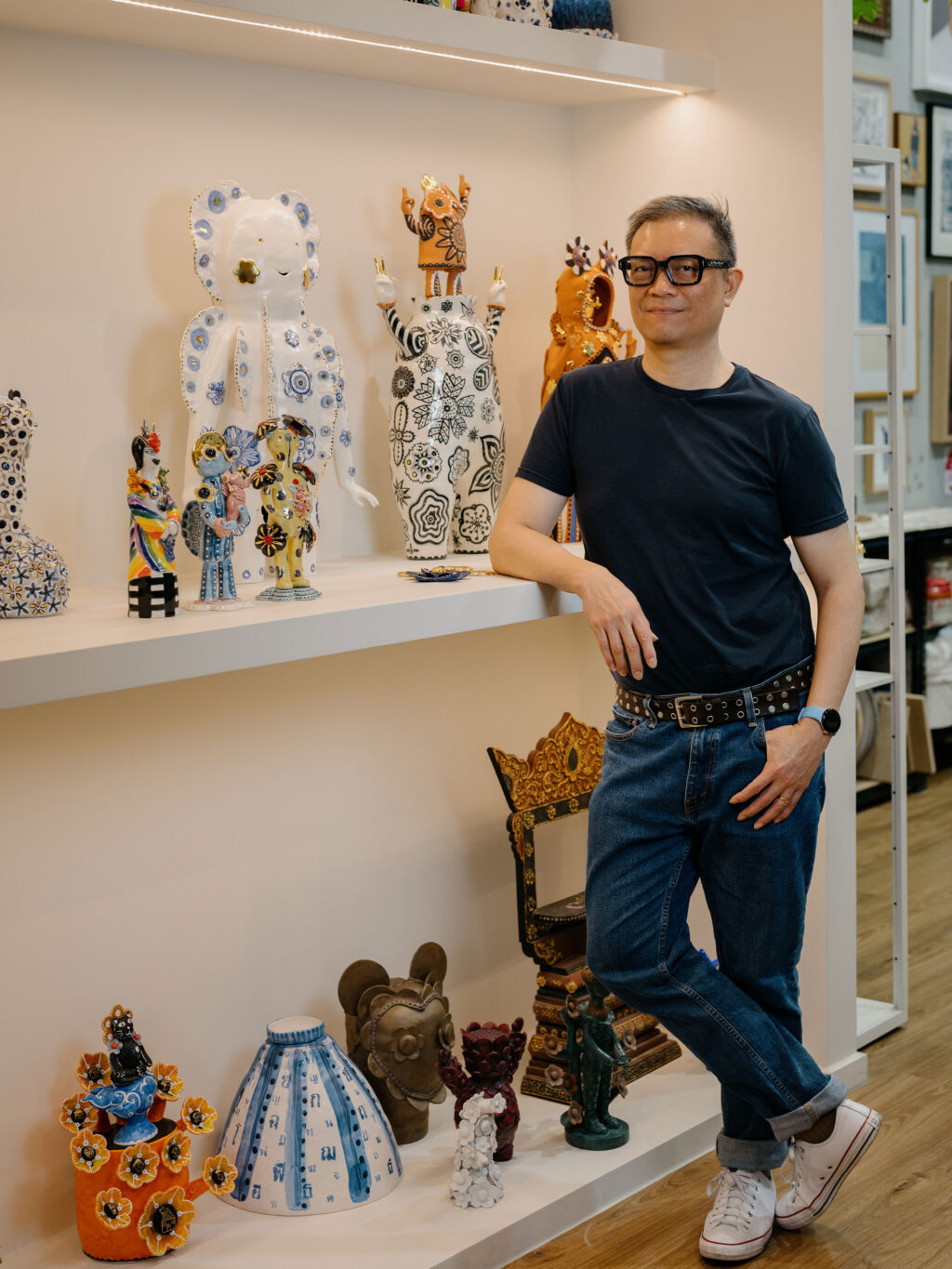
Photo courtesy the artist and Föenander Galleries.
The eighth sculpture draws on your grandmother’s button and your own migration story. Why was it important to include your personal narrative within this broader framework?
Originally, the project involved seven donated objects, but I realised I had time and space to make one more work. I decided to include my own story so I could experience the same emotional process as the participants.
Using my grandmother’s button allowed me to reflect on my own migration and personal history. It felt important to place myself within the project, not as an observer but as someone equally vulnerable. By asking myself the same questions I asked others, I gained a deeper understanding of what participants have experienced.
What’s an object you have, and might not need, but still can’t bring yourself to throw away?
The blue and white porcelain buttons that belonged to my grandmother. They are called Lai Kram, which means “blue and white pattern.” I believe this is why I am so drawn to blue and white ceramics. It has been part of my subconscious for as long as I can remember.
I brought the buttons with me to Australia because they are precious to me. They carry memories of my childhood and remind me of my roots and of my grandmother, who was very stylish. The buttons don’t form a complete set, and although I once tried to turn them into a necklace to wear, it didn’t quite work. Instead, I used them to create a necklace for one of my sculptures.
Ideally, I would love to one day find a complete set and use them as buttons on my shirt.
Do you have any rituals that help you get in the right mindset to work?
I usually go to the studio early in the morning and take my time planning what I want to do. Drinking sencha tea has become an important morning ritual for me. It’s a way of training my brain to recognise that creative work is about to begin.
By repeating this ritual every day, my body and mind ease naturally into work mode. When I feel blocked or uninspired, I return to tea-making. The more elaborate the process, the better. That’s probably why I’ve collected so many teapots, teacups, and different tea leaves over the years.
What will you be presenting at Melbourne Art Fair?
I will be presenting a series of ceramic figures titled Fortune Teller Deities. The works are created as quiet companions for everyday life. Each deity is named for a small but meaningful role: helping, listening, protecting, or encouraging, offering support not through prediction, but through presence.
Rather than foretelling the future, the figures acknowledge common human experiences such as uncertainty, hope, fatigue, longing, courage, and the desire for reassurance…in a very positive and fun way.
Vipoo Srivilasa, The Hope Keeper, 2026, Glazed earthenware with gold lustre and synthetic polymer paint. 240 x 150 x 90mm.
Looking to the future, are there any new ideas or themes you wish to explore in your work?
I love working with food and with people, and I hope to expand this further in future projects. I’ve already explored food-based works, but I’m also interested in developing projects around drinks. Ceramics can create beautiful vessels for drinks!
I’m particularly interested in the possibility of collaborating with people from other disciplines, such as mixologists. I think that combination could lead to exciting and meaningful outcomes.
Vipoo Srivilasa will be showing at Melbourne Art Fair 2026 with Föenander Galleries, Booth K2
Melbourne Art Fair ambassador, entrepreneur and all-around icon Rebecca Harding has done the hard work for us, pulling together a short list of some must-see moments landing at Melbourne Art Fair next week.
I’m excited to see Corban Clause Williams’ solo exhibition. I spent some time living in Newman where he was born, and have seen firsthand the beauty of those Pilbara landscapes. Through his incredible works, he shares ancestral stories with a contemporary lens.
Corban Clause Williams, Kaalpa. Photo: Tamisha Williams
SIMON ZORIC
LON GALLERY (NAARM/MELBOURNE) BOOTH H4
Simon Zoric creates with humour and an element of cheekiness. He playfully pokes at contemporary art, cultural institutions and the weird contradictions of modern life. This is my partner’s favorite kind of art, albeit slightly crude.
Simon Zoric,Contemporary Art, 2018, Acrylic on canvas, 174 x 250cm. Courtesy the artist and LON Gallery.
HEIDI YARDLEY
NICHOLAS THOMPSON GALLERY BOOTH G7
Each painting by Heidi could be a snapshot from a film or a hazy memory. There’s so much beauty and mystery in every painting which invites us as viewers to imagine the scenario rather than read it explicitly.
Heidi Yardley, Bitter summer in decline (detail), 2024, oil on linen, 65 x 50 cm. Courtesy the artist and Nicholas Thompson Gallery.
NATASHA WALSH
N.SMITH GALLERY BOOTH A5
I love Natasha Walsh’s works on copper, a material that starts oxidising from the moment she begins. Her paintings visibly age as she works on them. A nice reminder that time doesn’t stop for anyone.
Natasha Walsh, Dreaming of rose scented tea leaves carried to me on a summer breeze, 2025, oil & pigment on copper, 74 x 100 cm.
VOLHER HAUG STUDIO
All of Volker’s work is incredible. I love that he dances the line of playfulness and practicality. His pieces are sculptural, like objects you notice and live with rather than purely functional lighting.
RebeccaHarding moves fluidly between fashion, beauty, and design. As the founder of LUI, a luxury razor and body care brand made for women, by women, she brings a sculptural eye and a designer’s precision to the rituals of self-care.
Her career has spanned global campaigns for Louis Vuitton, Fendi, and Hugo Boss, brand ambassadorships with Lancôme and Kérastase, and a long-standing partnership with Ralph Lauren. Regularly featured in Vogue, Harper’s Bazaar, and Marie Claire, she brings a refined sensibility to everything she touches part entrepreneur, part aesthete.
Melbourne Art Fair, 19 – 22 February 2026 at the Melbourne Convention and Exhibition Centre.
The body has long been the focus of Zoë Croggon’s work. Working with sculpture, video, drawing and primarily collage, Zoë’s practice considers the relationship between the kinetic body and its surroundings, contemplating the role we play in our environment and how deeply our surroundings inform the cadence of our lives. Created primarily from found photographs, her works study texture, light, and form, examining the possibilities and limits of pictorial abstraction and metamorphosis.
This month, Naarm/Melbourne-based contemporary art gallery, Daine Singerwill exhibit a new series of new works by Zoë Croggon in anexpertly curated solo presentation at Melbourne Art Fair. Dedicated to facilitating a deep exploration of artistic practice, Melbourne Art Fair spoke with Zoë and gained insight into her artistic process.
Your use of collage involves bringing disparate elements from various sources together. How do you navigate the tension between preserving the original identity of individual images and creating a new conceptual whole?
I think it is a balancing act that ultimately has to be intuited. The work really depends on the brain’s propensity for pattern recognition; synthesising new information with old, amalgamating disparate pieces of data, or in my case, perceiving two distinct images severed from their referent and function as a coherent whole, even if just for a moment. In an interview with Michael Bracewell for Frieze, John Stezaker talks about the metamorphosis of the image in collage, “I’m very much a follower of Maurice Blanchot’s ideas when it comes to image and fascination; he sees it as a necessary series of deaths that the image has to go through in order to become visible and disconnected from its ordinary referent. I don’t know whether that’s an ideal, but I suppose it could be a guiding principle.”
Your works are largely concerned with the relationship between the kinetic body and its surroundings, contemplating how the built environment can inform the cadence of our lives. Can you expand on how this concept is explored in your work? Has it evolved throughout your career?
I suppose the work is asking how to be in the world, how to live in a body that occupies space. One of the reasons I love dance is because it is the language of the body in conversation with its environment. I’m interested in the shifts that occur physically and psychologically when our surroundings change, even slightly, like when a cloud obscures the light of the sun. It is the interconnectivity of things that compels me (and which I think always will), which is why my work often poises the human form and its built environment somewhat as equals, the body no longer occupying space and space no longer determining the body but each existing only in relation to the other, completed by the other.
Zoë Croggon, Seeing Darkly, 2023, collage of found images and glue on paper, Perspex frame, 47.6 x 36.7 x 7 cm framed.
When creating a new piece, how do you work through forming a composition? What is your process in deciding where to make a cut and where to piece it together to create something new?
It is quite intuitive and immediate, I tend to cut and compose until I feel like the images speak to each other, it is really a process of trial and error. The decisive “cut” in collage can feel violent at times, especially working so much with photographs of the body. I like working in collage because it is full of contradictions, it is a medium that is simultaneously constructive and destructive. Collage encompasses the violation of copyright, the destruction of an image and the severing of a pictorial body, all of which are countered by the creation of a new image, the preservation and resurrection of discarded material, and ultimately the search for harmony within division and fragmentation.
Incorporating images from sports encyclopedias, photography manuals, film stills, and dance catalogues, your collages span diverse subject matter. What is your selection process in sourcing these images?
I cast a pretty wide net, and although I have inclinations toward certain material (botanical photography and yoga manuals are favourites), I am often surprised at the beauty that can be found in books or magazines that I would generally ignore. I only source second hand printed material, which comes less from a persistent nostalgia and more from the fact that I wouldn’t know where to begin looking online, it feels both too nebulous and too specific. I try to be thorough, but I am happy for my work to be led by the material I find.
Photos courtesy the artist and Daine Singer (Naarm/Melbourne)
Your older works feature the athletic form – the dancer’s body often in juxtaposition with architectural features. There seems to be a slight shift in your new works which often feature editorial images from fashion magazines. Is this an intentional shift in the subject matter or do you view it as a natural evolution of your work?
I generally allow my source material to define my work and determine its aesthetic direction. During the lockdowns in Melbourne, when second hand bookshops and fine art printers were closed, I turned to the collections of magazines I had in my studio. I wanted to find a way to use the entire magazine as “the work” while playing with a sculptural three dimensionality. I was thinking about the relationship between content and process, wondering if there was a way I could imitate the lush smooth garments featured in these magazines in how I make the work – the pages are curled, folded and tucked, mimicking the textural pliancy of fabric. I wanted to pair formal symmetries within the magazine while heightening the surgically polished and disembodied female form.
Explore and collect Zoë Croggon’s works at Melbourne Art Fair, 22-25 February 2024 at the Melbourne Convention and Exhibition Centre. Secure your tickets here.
);">
Ali Tahayori On Mobilising Light, Āine-Kāri And His New Works For Melbourne Art Fair
Ali Tahayori’s interdisciplinary practice ranges from conceptual photography to the moving image, and installation. He uses archival materials, narrative fragments and performative modalities to explore themes of identity, home, and belonging. Combining fractured mirrors with text and imagery, his works draw on ancient Iranian philosophies about light and mirrors to create kaleidoscopic experiences; moments of both revelation and concealment hint at the conflicted nature of his identity. Born in Shiraz, Iran, Ali currently lives and works in Gadigal Country/Sydney.
Ali Tahayori is represented by THIS IS NO FANTASY, a Naarm/Melbourne based gallery, recognised for discovering and managing the careers of a small, select and diverse group of artists shaping Australia’s art discourse, both locally and internationally. Find THIS IS NO FANTASY and Ali Tahayori’s work at Melbourne Art Fair, Booth C4.
Committed to showcasing new and iconic artists with a focus on solo shows and works of scale and significance, Melbourne Art Fair spoke with Ali about his unique artistic practice.
An integral part of your work is your ability to translate the traditional Iranian craft of Āine-Kāri (mirror-works) into a contemporary visual vocabulary of your own. Can you expand on your fascination with this traditional craft and how you both embrace and subvert the notion of ‘tradition’ within your works?
My fascination with Āine-Kāri started when I was five years old, when, for the first time, I entered the shrine of Shah-Cheragh in my hometown, Shiraz, a mosque where the interior is covered with tiny mirror fragments. Being in that place was transcendental.
What I do in my practice is not translation as such, but mobilisation. I am interested in the notion of “hybridity”. I like moving ideas, materials, and processes across places and temporalities. If you look at the history of Āine-Kāri, you realize that the craft was developed to reuse and recycle broken mirrors imported from Europe. So, the mirrors were brought to Persia from another place, then turned into something uniquely Iranian, and now I am presenting my own version of it outside of Iran. By moving ideas and materials from one place to another, I question the notion of borders.
Detail image courtesy of the artist and THIS IS NO FANTASY.
Your works form to create a unique sensory experience through its kaleidoscopic effect. Can you elaborate on your consideration of light as a guiding principle in your work? Do you wish to exert a particular level of control over the light your work reflects or do you wish to relinquish a sense of control to the environment within which your works are shown and to who it is shown to?
Whether I work in Photography, moving image or installation, light is integral to my practice. I first became interested in light and studied it in my photography studio’s dark room, where everything dissolves in darkness. Then you introduce light, and something magical happens. That’s why I am more interested in video projections than showing the same video on a TV monitor; video projections reveal the luminous quality of images. In my video installations, I start with pure darkness and gradually introduce light. My approach to working with light is playful and experimental but also considered. Each project demands a particular aesthetic and sensory effect; based on that, the intensity, colour, contrast, and other qualities of light vary.
Expanding on the above, your work is deeply influenced by your personal experiences of being ‘othered’; from growing up in the homophobic environment of 1980s Iran to embodying the migrant experience through your move to Australia. How do your works reflect the complexities of identity and your experience of queerness, of being seen and unseen?
I work at the intersection of queer diasporic subjectivities and aim to amplify untold stories of violence and historical oppression, but also of resilience, community, belonging and celebration. The mirror, especially the way I use it, broken and fragmented, is a unique material to reflect on topics such as identity, queerness, and otherness while questioning the nature of representation.
Detail image courtesy of the artist and THIS IS NO FANTASY.
How does your process evolve when creating each work? How do you go from ideation to final artwork when working in a multi-disciplinary capacity ranging from photography, moving image and installation?
My approach to artmaking is intuitive and informed by research and my daily experience. A concept or an idea emerges, and it usually comes while I’m working on a different project. The concept then goes on a journey. I start researching the field in which I’m working, and the idea begins to find a material form. Material is a big part of my practice. There is often a dialogue between concept, material, and form. I try to be a good listener, but sometimes I’m not, and I only find out when the work is exhibited.
Can you provide any insights on the work you are developing for Melbourne Art Fair and how it relates to your broader body of work?
I am very excited to show a few works from my new project, Archive of Longing, at the Melbourne Art Fair, works I have not exhibited elsewhere yet. The project is, in a way, a return to the archive, and it embodies so many aspects of my practice: my interest in the materiality of images, questions of representation and photography’s in(ability) to represent reality, and my love and obsession with the medium’s history. Later in the year, I’ll exhibit part of this project in Milan and London.
Detail image courtesy of the artist and THIS IS NO FANTASY.
Explore and collect Ali Tahayori’s work at Melbourne Art Fair 2024. The Fair takes place 22 – 25 February at Melbourne Convention and Exhibition Centre. Secure tickets now.
);">
Alex and Georgie Cleary: 5 Stories on Creative Collaboration
The siblings behind Australian fashion label Alpha60 reflect on working with Patricia Piccinini and Brendan Huntley, and introduce their latest project for Melbourne Art Fair.
Siblings Alex and Georgie Cleary are ‘hustlers since way back’.
The duo’s working relationship began on their parent’s rose farm, where they sold flowers together on the side of the road—an enterprise which expanded to selling tea towels, potpourri, muffins, and later champagne, skateboards, and t-shirts at the local market.
With past careers in graphic design (Georgie) and aeronautical engineering (Alex), their fashion label Alpha60 emerged organically over time, beginning when Georgie made Alex a printed t-shirt to go out in one night when he had nothing to wear. The shirt was soon requested by growing numbers of friends, and from there the brand grew. ‘We just made stuff that we liked, and that’s still what we do,’ Georgie said.
For Melbourne Art Fair 2024, they are presenting two PROJECT ROOMS with Firstdraft, a non-profit contemporary art space in Gadigal Country/Sydney, and Gertrude, an artist studio programme in Naarm/Melbourne, as well as their own booth where they will launch three new bag designs—the product of their latest collaborations with Australian artists Mikala Dwyer, Lottie Consalvo, and Kate Rohde.
Alex and Georgie recently spoke with the team at Ocula about collecting, previous collaborations, and their current project for Melbourne Art Fair 2024.
“GC: Funnily enough, we’ve collected a lot of things that are exactly the same—from the same artist, same gallery, same exhibition. It’s funny because our houses are so different, but we’ve got a lot of the same art.”
Exhibition view: Alpha60 X Brendan Huntley: Sense of Direction, Heide Modern, Melbourne (11 March–10 April 2023). Courtesy the artists and Heide Museum of Modern Art. Photo: Clytie Meredith.
);">
Five Must-See Solo Presentations at Melbourne Art Fair 2024
The 17th edition will build on Melbourne Art Fair’s reputation to present ambitious works of scale and significance, with a number of galleries presenting solo shows by new and iconic contemporary artists.
Melbourne Art Fair returns in the bookend of the Australian summer, taking place 22 – 25 February 2024 at the Denton Corker Marshall designed Melbourne Convention and Exhibition Centre to launch the region’s annual arts calendar. Part of the Fair’s allure is its ability to facilitate a deep engagement and exploration of artistic practice through showcasing individual artists, setting itself apart from other fairs in the region.
In anticipation, here are five unmissable solo shows coming to the Fair next year.
An Australian artist of Burmese descent, Shan Turner-Carroll is deeply fascinated with unearthing tacit knowledge. His practice integrates mediums including photography, sculpture, performance and film, interrogating human and non-human nature, alternative forms of social exchange and interactions between art, artist and viewer: sending and receiving signals. Turner-Carroll sees art-making as ritualistic and transformative, using play, humor and experimentation as key elements within his current practice. His work can sing to snakes, serenade and signal with aliens, and barter with islands, rivers, and oceans.
At the fair next year, Gadigal Country/Sydney-based contemporary art space, COMA, will present a new body of work by Turner-Carroll, supported by a small sculptural incursion. The series of photographs will riff off his previous series, Edge of the Garden.
Turner-Carroll’s work is included in the collections of Art Gallery of New South Wales, Sydney; Maitland Regional Art Gallery, Maitland, Australia; The Macquarie Bank Collection; The University of Newcastle, Newcastle, Australia; Curve Gallery, Newcastle, Australia.
Image: Shan Turner-Carroll, Edge of the Garden, Dad, 2020, archival digital ink jet print, 108 x 71.5 cm (unframed), edition of 6. Courtesy the artist and COMA (Gadigal Country/Sydney).
Following Wanapati Yunupiŋu’s stand-out, sellout exhibition in 2022, the Yolŋu artist is set to return to the Fair’s next edition in a solo show with Tolarno Galleries in partnership with Buku-Larrnggay Mulka Centre. Yunupiŋu creates new dynamic sculptural works that will offer a ‘new landscape’ composed of contemporary interpretations of sacred designs on discarded materials found on homelands.
Through his artistic practice, Yunupiŋu has quickly forged his own style, etching his sacred Gumatj clan designs and narratives into the face of discarded street signs, twisted metal, and aluminium surfaces that litter the landscape. As he pushes into new art territory, dreaming of creating large-scale works, he continues to explore his vision that Australian art is ‘one landscape’ – at once contemporary and Indigenous.
Yunupiŋu lives in the remote Gumatj homeland of Biranybirany, North East Arnhemland in the Northern Territory. He is the son of deceased artist and spiritual leader Miniyawany Yunupiŋu from whom he inherited rich ceremonial instruction.
His works are included in the collections of the National Gallery of Victoria (NGV) and the Art Gallery of NSW. Previously, his work as been exhibited at the Seattle Art Museum, the Museum and Art Gallery of the Northern Territory (MAGNT) and Everywhen Artspace in the Mornington Peninsula.
Image: Wanapati Yunupiŋu, Gumatj fire Gurtha Wanapati metal, 2023 Mixed media 91 x 60.5 cm. Courtesy the artist and Tolarno Galleries (Naarm/Melbourne).
Daine Singer (Naarm/Melbourne) will be showcasing a new series of dynamic, three-dimensional magazine collage works by Naarm-based artist, Zoë Croggon.
Croggon works with sculpture, video, drawing and primarily, collage. Her practice considers the relationship between the kinetic body and its surroundings, contemplating the role we play in our environment and how deeply our surroundings inform the cadence of our lives. The body has long been the focus of Croggon’s work, presenting the trained body and modern architecture as fascinating counterparts; each unyielding, severe, and rigorously functional in form. Created primarily from found photographs, her works study texture, light, and form, examining the possibilities and limits of pictorial abstraction and metamorphosis.
Croggon has exhibited work in solo exhibitions with the NGV, Gertrude Contemporary, Peckham 24 (London), Silver Eye Centre for Photography (Pittsburgh), MPRG, Perth Centre for Photography, Daine Singer and MAF. Additionally, Croggon has won he Maddocks Prize, AGNSW Scholarship at the Cité Paris (2018), ARTAND/Credit Suisse Award, Asia-Pacific Photobook Prize and the ACACIA Award.
Image: Zoë Croggon, Centrefold, 2022, collage of found images and glue on paper, Perspex frame 47.6 x 36.7 x 7 cm (framed). Courtesy the artist and Daine Singer (Naarm/Melbourne).
Combining painting and sculpture, Martin Browne Contemporary will curate two solo presentations by Ildiko Kovacs and Virginia Leonard. Creating a dialogue, the two shows will respond to each other – with gestural and expressive large scale paintings by Kovacs complemented by a large sculptural work by Leonard in the form of a fountain with a recirculating water supply.
Kovacs’ paintings rely on gesture and speak of painting as a physical act that relates to bodily movement. The processes of layering, accumulating and removing paint over time are also central aspects of her practice. Exhibiting since the 1980s, her work has been shown in a number of exhibitions, including The DNA of Colour at the Orange Regional Gallery, Canberra (2019) and Cat’s Cradle at Raft ArtSpace, Alice Springs (2018). Her works are included in the collections of the National Gallery of Australia, Canberra; Newcastle Regional Art Gallery, NSW; National Gallery of Victoria, Melbourne; Bathurst Regional Gallery, NSW; and various private collections.
Leonard’s emotive and intensely powerful works address her bodily scarring and experiences of chronic pain. The language of the clay-making is an attempt to rid her body of trauma and reduce her level of chronic pain. Clay is visceral, oozy and clumpy. It resembles bodily scarring but is also a precarious medium, which serves as a reminder of the fragility of her body. The Aotearoa/New Zealand-based artist has exhibited internationally, including Design Miami with Mindy Solomon Gallery in the US and the Australian Ceramics Triennale in Alice Springs.
Images: (1) Ildiko Kovacs, Whit Sunday, 2023, oil on plywood, 160 x 244cm. Photograph: Jessica Maurer. (2) Virginia Leonard, I Promise, 2023, clay, lustre and resin, 48.5 x 40cm. Photograph: Sam Hartnett. Images courtesy the artists and Martin Browne Contemporary (Gadigal Country/Sydney).
Australasia’s Most Sustainable Art Fair Partners With Clima to Offset Carbon Footprint
Claiming the title of Australasia’s most sustainable art fair since 2022, in 2024 Melbourne Art Fair partners with Climato continue leading the way in carbon emissions reduction for the artworld. Clima supports Melbourne Art Fair to understand its emissions and balance these with bespoke portfolios of carbon projects which combat climate change, while bringing additional environmental and social benefits across the globe. Motivated by the global climate emergency, Melbourne Art Fair has committed $1.50 from every ticket purchased to a portfolio of offset projects and is providing attendees agency to choose which project to support.
Attendees can choose from three different projects, each formed in line with the United Nations Sustainable Development Goals.
Based in Queensland, this project aims to support traditional land management.
Greenhouse gases emitted from savanna fires average 3% of Australia’s emissions. By collaborating, Traditional Owners and Aboriginal rangers implement controlled, cooler fires in the early dry season, reducing greenhouse gas emissions compared to the intense, uncontrolled fires that arise later when the land is dry.
When savanna grasslands are burned in a controlled manner, it can stimulate the growth of new grasses and other vegetation, which in turn provides food and habitat for a wide range of local species. Cool burning can also help to control the spread of invasive species, reduces the risk of wildfire, and improves the overall health and resilience of the ecosystem.
Traditional cooking methods in Malawi often involve open fires or rudimentary stoves, which are highly inefficient and result in excessive wood consumption, deforestation and significant carbon emissions.
One of the primary objectives of the project is to develop and promote the use of improved cookstoves. These new cookstoves are designed to be more fuel-efficient, allowing for a significant reduction in the amount of wood needed for cooking.
With a decrease in wood needed for the same outcomes, pressure on local forests is lowered and less labour is required for wood gathering – a labour-intensive and often dangerous task that is usually undertaken by women. In addition, the efficient stoves improve air quality in confined cooking spaces by reducing smoke levels and other airborne pollutants.
This project aims to restore and maintain tidal ecosystems in the Indus Delta Area of south-eastern Pakistan, with the goal of contributing to climate change mitigation, increasing carbon storage, conserving biodiversity, and improving the livelihoods of local communities. The project will focus on regenerating native coastal vegetation and habitat, specifically tidal wetlands and mangroves.
Tidal wetlands are important marine ecosystems that provide a range of benefits, including protecting the coastline from erosion, supporting a diverse array of aquatic organisms, and supporting the economic livelihoods of coastal communities.
In addition to partnering with Clima, Melbourne Art Fair takes place in the Denton Corker Marshall designed Melbourne Convention and Exhibition Centre (MCEC) where the venue has made sustainability a priority. MCEC has achieved Platinum Certification through EarthCheck, the world’s leading business advisory group specialising in sustainability and destination management for the travel and tourism industry. The world-class exhibition venue is one of only 6 convention centres in internationally to achieve this status and take meaningful steps towards resolving some of the very real issues that face the planet. Further, their future environmental targets include diverting 90% of waste by 2025 and becoming fully powered by renewable electricity by 2028.
Together with the Fair’s home, its carbon offset commitment, and an investment in reusable exhibition walling and LED lights, Melbourne Art Fair proudly maintains its position as Australasia’s most sustainable art fair.
Julie Rrap Awarded Major 2024 Melbourne Art Foundation Commission in Partnership with Art Gallery of Western Australia
Melbourne Art Foundation is thrilled to announce Julie Rrap represented by Roslyn Oxley9 Gallery (Gadigal Country/Sydney), as the recipient of the $100,000 2024 Commission in partnership with the Art Gallery of Western Australia (AGWA) and supported by Artwork Transport and Creative Australia
SOMOS (Standing On My Own Shoulders) is the 10th commission of the program and is set to be unveiled at the 17th iteration of Melbourne Art Fair.
Rrap, one of Australia’s most recognised female artists, is widely considered to have contributed to the foundations of contemporary feminist art in Australia. Working for over four decades with a range of different mediums, Rrap’s work challenges, subverts and reinterprets the definition of women and their image in surprising ways, often using her own nude body to do so.
The major work will respond to the Fair’s artistic program thematic – ketherba / together, “SOMOS (Standing On My Own Shoulders), is a bronze life-size sculptural work that is a dynamic composition in which both casts of my body are caught in a moment of action as one figure appears to support the other on its shoulders,” said Julie Rrap. “While SOMOS echoes the “heroic” tradition of bronze figurative sculpture, it subverts that history by representing an older female body traditionally rendered invisible. This work strongly consolidates many of the concerns that have preoccupied me in my practice over the last 40 years and to have the opportunity to create SOMOS as a major work for this commission and the Art Gallery of Western Australia is a career highlight and one which will create an incredibly important conversation.”
After its unveiling at Melbourne Art Fair 2024, SOMOS will head to the Museum of Contemporary Art Australia (MCA) for Rrap’s exhibition titled Past Continuous opening June 2024. It will then move to its permanent home in the AGWA collection.
Colin Walker, Director/CEO, Art Gallery of Western Australia said:“AGWA is incredibly excited to announce our partnership with the MAF to commission a major new sculptural work by Julie Rrap. Titled SOMOS (Standing On My Own Shoulders) it is literally that, a near life-size self portrait of the artist holding herself aloft. A work Rrap has been planning for many years, we couldn’t be more thrilled that the AGWA/MAF relationship has been able to support her longstanding vision. From her first exhibition in the early 1980s to now Rrap has proved herself to be one of Australian most important artists, known for her consistently compelling exploration of the nexus between gender and power, meaning and materials. Her first major piece in bronze, SOMOS will have a prominent place on AGWA’s rooftop alongside significant collection works including Chris Pease’s 34m long mural.”
Roslyn Oxley, Director, Roslyn Oxley9 Gallery said: “This fabulous new large-scale sculptural work represents a truly remarkable opportunity for Julie to delve further into her exploration of the female body, a theme that has been at the heart of her artistic practice for over four decades. Julie’s desire to bring ‘SOMOS (Standing On My Own Shoulders)’ to life has been a long-held aspiration, and I am eagerly anticipating the realisation of her vision. This daring bronze masterpiece will challenge established norms in the portrayal of the female body and ignite an essential conversation, making it yet another pivotal moment in Julie’s prolific career.”
Established in 2006, the Melbourne Art Foundation Commission Program provides a living artist with a rare opportunity to realise an ambitious work for unveiling at Melbourne Art Fair, which is later gifted to a prominent Australian Institution.
Melbourne Art Fair returns in the Victorian Summer from 22-25 February 2024, bringing together 60 of the region’s leading galleries and Indigenous art centres, spanning 7,500sqm at the Denton Corker Marshall designed Melbourne Convention and Exhibition Centre.
Melbourne Art Fair Appoints Anador Walsh as Curator of LIVE
Melbourne Art Fair is delighted to announce the appointment of Anador Walsh as Curator of LIVE for the 17th iteration of the Fair.
LIVE, subtitled Performing Care, is an onsite performance program that will present a series of new commissions by an emergent generation of Naarm-based performance artists during Melbourne Art Fair. In response to the Fair’s thematic, ????????, this program brings core members of the Performance Review community to the table to share in this opportunity and ponder how performance can best be cared for and represented in an art fair context.
Anador Walsh is a Naarm-based curator, writer and the founding director of Performance Review. In 2020, Walsh took part in the Gertrude Emerging Writers Program and was the 2019 recipient of the BLINDSIDE Emerging Curator Mentorship. She is the curator of ‘Contact High’, Gertrude and Performance Review’s annual performance program and in 2022 curated the Naarm premiere of Angela Goh’s ‘Body Loss’ at the Ian Potter Centre: NGV Australia for Melbourne Art Fair. She has written for Art Guide, Runway Journal, Memo Review, ACCA, PICA and the NGV and regularly contributes to The Saturday Paper. Until 2018, Walsh was Gertrude’s Marketing and Development Manager.
Performance Review (established 2021) is a space for the development of discursive and experimental writing about live art. Through partnerships with Gertrude, Melbourne Art Fair and the Keir Choreographic Award, in 2022 Performance Review also began presenting performance and covering theatre-based dance, prioritising new opportunities for emerging writers and artists engaged with this medium.
Post edited 15 Feb 2024: LIVE will not be presented in the Melbourne Art Fair 2024 Program
);">
Melbourne Art Foundation Launches William Mora Indigenous Art Centre Program
Melbourne Art Foundation today announces the launch of the William Mora Indigenous Art Centre Program; supporting the fully funded participation of Indigenous-owned Art Centres at Melbourne Art Fair 2024 with an aim to promote and provide curatorial and commercial opportunities for Indigenous Australian artists working on Country and in communities across Australia.
Supported by the Australian Government Office for the Arts Indigenous Visual Arts Industry Support (IVAIS) Program, the program will provide a fully funded exhibition package for four Indigenous-owned Art Centres to participate in the 17th edition of Australasia’s premier contemporary art fair, Melbourne Art Fair.
This program has been developed in response to the successful Melbourne Art Fair 2022 IACP program, which was generously funded by both the Restart Investment to Sustain and Expand (RISE) and IVAIS Funds, and delivered with the support of Agency Projects. The 2022 program provided unparalleled curatorial and commercial opportunities for participating art centres, generating an estimated $450K in total artwork sales for the five participants across the four-day fair. Indigenous-owned Art Centres participating in the 2024 program include Moa Arts; Munpui Arts & Crafts Association; Papunya Tjupi Arts; and Wik & Kugu Arts Centre.
The Melbourne Art Fair 2024 William Mora Indigenous Art Centre Program is funded by the Australian Government Office for the Arts Indigenous Visual Arts Industry Support (IVAIS) Program, and generously supported by Bennelong Funds Management and Morgans. The program will once again contribute to a high-quality platform for Australian contemporary art and respond to the increasing national and international interest in collecting work by Indigenous Australian artists.
Melbourne Art Foundation CEO and Fair Director, Maree Di Pasquale, says“Melbourne Art Foundation acknowledges the continued and generous support of the Australian Government Office for the Arts and its Indigenous Visual Arts Industry Support program. This important initiative will build on the success of a landmark 2022 program and enable art centres to continue to access new markets through participation in a contemporary fair of global significance. We look forward to connecting an international network of Melbourne Art Fair collectors, curators and buyers to some of the most exciting and critically significant work being produced in Australia today.”
Melbourne Art Fair returns in the Australian summer, 22 – 25 February 2024 at the Melbourne Convention and Exhibition Centre, to present new and iconic artists from 60 of the region’s leading contemporary art galleries and Indigenous-owned Art Centres.
The William Mora Indigenous Art Centre Program is named in honour of the late William Mora, a Victorian art dealer and cultural patron who championed meaningful connections with Indigenous-owned Art Centres within the commercial gallery and art fair context. This program recognises the vital role art centres play in sustaining First Nations arts and communities, and in sharing the stories of Australia’s First Peoples.
Image: Patsy Mudgedell, Untitled, 2021. Courtesy Patsy Mudgedell and Warlayirti Artists. Melbourne Art Fair 2022 Indigenous Centre Art Program.
);">
Melbourne Art Fair presents INDEPENDENT, a library of substance and significance
Melbourne Art Fair believes in the power of art to champion new ideas and push established ones forward. Every element of the Fair seeks to thrust ideas to the fore, to provoke thought and stimulate understanding. In recognising the written words as a distinct and vital art form and essential mode of knowledge sharing, the 2022 edition of Melbourne Art Fair presents a new initiative: INDEPENDENT, a curated library of books spanning art, cultural commentary, design, architecture, fashion, and humanities.
INDEPENDENT will bring together significant and revered independent booksellers, publishers, and writers to represent a broad spectrum of ideas that challenge our perceptions and deepen our connection to these forces in our lives. Presented as a singular open-plan library, INDEPENDENT represents ideas in an in-depth and rich manner, providing platform for First Nations, queer, gender diverse, and emerging voices in literature.
The inaugural line-up for INDEPENDENT features Perimeter Books, Bookshop by Uro, and Negative Press, each of whom represent contemporary culture through rigorous publishing programs and a superlative edit of titles addressing art, design, architecture, and social theory.
Jane Harrison, Festival Director for First Nations Literary Festival Blak & Bright, will curate a selection of titles from across the range from each bookseller that will champion and bring to the fore Indigenous voices, issues and works.
Discover INDEPENDENT at the Melbourne Art Fair in the main concourse, February 17 – 20, 2022.
Image: Bookshop by Uro in Collingwood Yards, Naarm/Melbourne
);">
Melbourne Art Foundation launches publication to mark the 2022 edition of Melbourne Art Fair
Melbourne Art Foundation is proud to present Melbourne Art Fair 2022: Djeembana–Place: a book offering insight into the arts landscape of Melbourne Art Fair and beyond in this crucial moment of re-emergence for the Australian arts sector. Functioning as a comprehensive guide to the 2022 edition of Melbourne Art Fair, discover works of scale and significance through commissions, installations, video works, live performance, and solo shows presented by leading regional and international galleries.
Featuring insight from foremost Australian art figures through conversations, essays, creative writing, and curatorial analysis, the publication offers a cross-section of the Fair’s expansive history and a vivid look at the contemporary cultural sector of Australasia and beyond, through the work of today’s most evocative living artists, from emerging to established. Uniting it all is an undercurrent of thoughtful ruminations on where we go from here.
Contributors include Alexie Glass-Kantor, Lisa Radford, Bronwyn Johnson, Mariam Cosic, Dr. Gene Sherman, Charles Justin, Ashley Crawford, Nevo Zisin, Hayley Millar Baker, Miriam Arcilla, and many more.
Copies of Melbourne Art Fair 2022: Djeembana-Place are available for online order HERE and can be collected on-site at Melbourne Art Fair or shipped Australia-wide.
);">
WE ACKNOWLEDGE THE TRADITIONAL OWNERS OF THE PLACE NOW CALLED VICTORIA, AND ALL FIRST PEOPLES LIVING AND WORKING ON THIS LAND. WE RECOGNISE AND CELEBRATE THE CULTURAL HERITAGE, CREATIVE CONTRIBUTIONS, AND STORIES OF THE FIRST PEOPLES OF VICTORIA. WE PAY RESPECT TO ELDERS OF TODAY, EMERGING ELDERS OF TOMORROW AND ELDERS OF THE PAST.
This site uses cookies to give you the best possible experience. By continuing to use the site you agree that we can save cookies on your device. Cookies are small text files placed on your device that remember your preferences and some details of your visit. Our cookies don’t collect personal information.


 );">


 );">

 );">


 );">


 );">


 );">

 );">


 );">


 );">
 );">
 );">
 );">
 );">
 );">