READ | Brenda L. Croft on Honouring Barangaroo’s Legacy, Inverting Tintypes Through Agency and more

Dr. Brenda L Croft is an esteemed multidisciplinary artist of Gurindji/Malngin/Mudburra heritage from the Victoria River region of the Northern Territory, and of Anglo-Australian/Chinese/German/Irish/Scottish descent. A selection of works of her photographic series, Naabámi (thou shall/will see): Barangaroo (army of me), will be presented at Melbourne Art Fair 2026, as part of BEYOND. The work pays tribute to Barangaroo, the Cammeraygal woman known for her unwavering stance as an unceded sovereign First Nations woman during early Australian colonisation. 

Speaking with Fair Director and BEYOND curator, Melissa Loughnan, Brenda reflects on her commitment to carry forward Barangaroo’s legacy, and on the ways her work foregrounds the strength, agency and presence of the First Nations women depicted in her photographs.

How were the women and girls in your Naabámi (thou shall/will see): Barangaroo (army of me) series selected? Do you have a personal relationship with any of them?

Many of the women I have known for decades and others were first-time participants. Subjects were selected as embodiments of Barangoo’s determination and our connection to her and other First Nations women: great-grandmothers, grandmothers, mothers, aunts, sisters, daughters, grand-daughters, cousins, friends. This body of work reflects these long-standing relationships and I hope that the respect and trust I feel for my subjects is reflected in the work and continues to help represent Australian First Nations communities and individuals from a culturally appropriate standpoint.

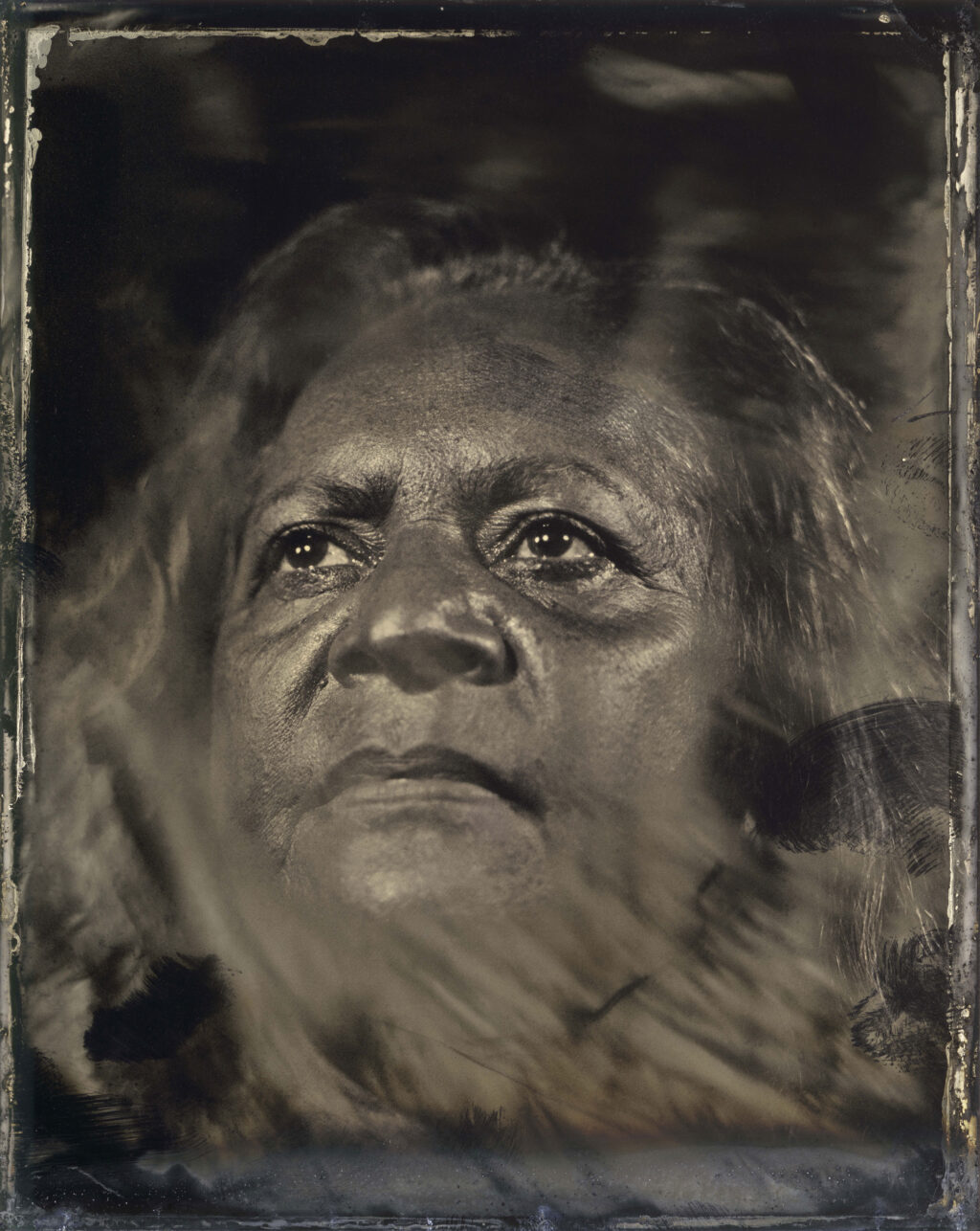
Brenda L. Croft, Julie (Dhulanyagan clan, Yorta Yorta/Wiradjuri/Wurundjeri Peoples), 2024 from Naabámi (thou shall/will see): Barangaroo (army of me), 143 x 112cm, inkjet print (from original tintype, wet plate collodion process) on archival paper. Image courtesy of the artist and Niagara Galleries (Naarm/Melbourne).

You have previously spoken about documenting the process behind this series through interviews with the participants. At what point did you do this and how did it inform the final works?

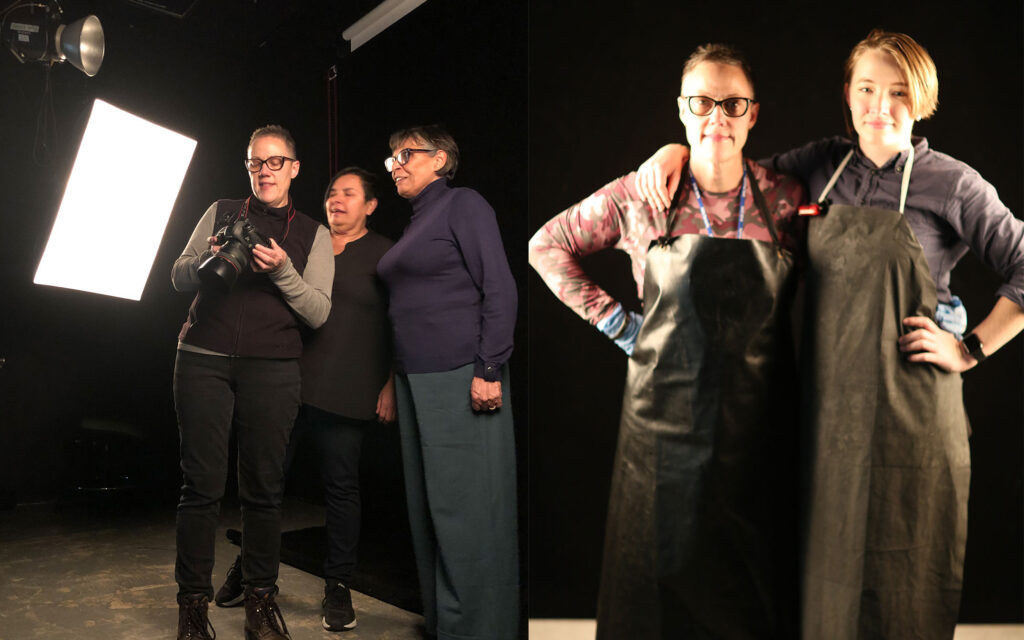
Photoshoots were staged across sometimes week-long periods with the invaluable assistance of Prue Hazelgrove in 2019, 2021 & 2023 in the studios of the Australian National University School of Art and Design and in 2022 at Carriageworks, Sydney. First Nations women and girls with cultural affiliations across the continent travelled to these locations to be photographed. We hosted family members across generations and took the time to talk, have a cup of tea and share a meal each day.

“During each session, participants were asked to look inward and consider what Barangaroo had endured during that fraught period of irrevocable change to her homelands and community, and to reflect on the First Nations women each has held close to them throughout their lives – great-grandmothers, grandmothers, mothers, aunts, sisters, daughters, grand-daughters, cousins, friends.”*

Behind the scenes of the photoshoots at Australian National University School of Art and Design, 2019. Left: Brenda L. Croft, Glenda Merritt and Violet Sheridan. Right: Brenda L. Croft and Prue Hazelgrove. Photos Courtesy Brenda L. Croft. 

Have any of your previous works honoured Barangaroo?

I have long worked with members of my patrilineal community to explore personal and by extension, family and community stories. I began this project named after Cammeraygal warrior woman Barangaroo (whose importance as a cultural negotiator has been all but erased) to honour ancestors – my own and those on whose sovereign, unceded lands I am privileged to live and work. Here Barangaroo is embodied and reflected back by the collective gaze – direct, challenging, averted, inward, beyond – of contemporary First Nations women and girls. Past, Present and Future.

First Nations women have long been an inspiration and the subject of my work: relatives, friends, ancestors and contemporaries. Elders in particular have been both muses and collaborators.

I want to draw attention to and carry on Barangaroo’s legacy as a staunch woman who stood her ground under enormous pressure and called out injustices. She was a cultural negotiator at the time of first colonial contact and like her, the participants in Nabaami series are firm in their cultural knowledge. Her name, subsumed by a wealthy precinct and casino in Sydney, needs to be reclaimed.

“The naming of Barangaroo Precinct [in 2007] prised open the colonial project of denial and negation, calling up the Cammeraygal woman who inspired the site’s selection for a highly desired part of Sydney’s CBD.”**

Your inversion of tintypes from colonial ethnographic use to contemporary First Nations Peoples use is compelling and significant. What first drew you to this method, and have you used this medium before?

Wet plate collodion processing, a nineteenth-century photographic technique, was a deliberate choice that I have used before. The process highlights everything the subjects have lived through and there are aspects of the finished image that cannot be controlled, including chemical mistakes. It’s not about making people look like something that they’re not. The process imbues all the subjects’ faces with a collective cultural resonance and power, an effect and impact that cannot be captured through film or digital processes.

This process was used in documenting many First Nations peoples in Australia as part of an ethnographic, eugenicist approach. First Nations people were documented as ‘dying races’ and rarely identified by language group and even less likely by name. I have identified each subject by name and community. Unlike the historical representation of individuals in tintypes, my subjects’ agency is acknowledged and highlighted.

Matilda (Ngambri), 2020 was the first of your works to be exhibited from the Naabámi (thou shall/will see): Barangaroo (army of me) series, followed by a selection at Sydney Festival 2023, along the Barangaroo Precinct waterfront; as an A/V projection onto Old Government House, Parramatta Park; and at the Museum of Sydney in 2023; then at the Australian Embassy in Washington DC, US from NAIDOC week 2024 to 7 February 2025; and most recently in ON COUNTRY: Photography from Australia in Les Rencontres de la Photographie d’Arles, France, 2025.
How did the reception of diverse iterations of this series differ across national and international borders?

Matilda I (Ngambri), 2020 was the first work from the series to be shown – it was shortlisted for the National Photographic Portrait Prize in 2020. From the moment the image appeared on the tintype developing tray I knew I would scan and enlarge it – it captures Dr Auntie Matilda House’s strength of character. Matilda is a powerhouse who has dedicated her life to the pursuit of social justice for Indigenous people. The image felt powerful and this was very well received at the National Portrait Gallery, where it was first exhibited.

Each iteration of the Naabámi (thou shall/will see): Barangaroo (army of me) has been quite different – not just the context within which the images were installed, but the manner of installation. The Barangaroo Precinct waterfront works were installed on sandstone blocks, cast-offs from colonial buildings, originally hewn from traditional lands. At the Art Gallery of New South Wales they were pinned unframed to the walls. Images were selected according to the relevance of the Country in which they were exhibited. Images have been projected and printed on both paper and metal.

This context was obviously quite different in France and the USA.

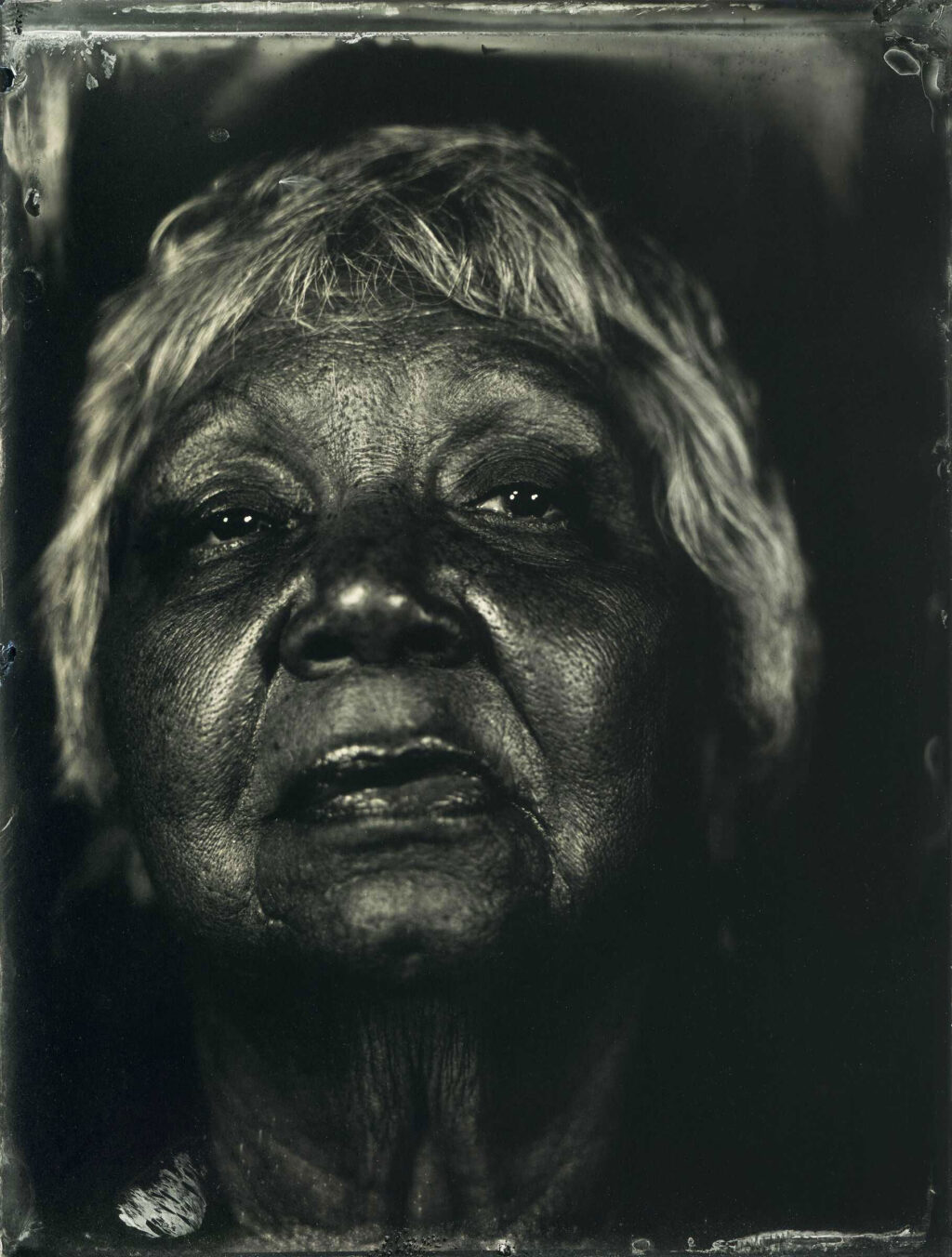
Matilda (Ngambri), 2020, Brenda L Croft, Prue Hazelgrove (wet plate collodion process technical assistant) and Richard Crampton (printer), from the series Naabami (Thou shall/will see): I am/we are Barangaroo, dye sublimation print on aluminium from tintype on paper, edition 4/5 + 3 APs. Image: 119.7 cm x 90.9 cm, sheet: 140.3 cm x 99.9 cm, frame: 153.0 cm x 113.0 cm depth 4.2 cm.

What significance does scale play in your work?

This series is printed larger than life. The impact of each print reflects the strength of character of the women and girls in this series and their gaze is hard to ignore. This is in direct contrast to the archival material that I have drawn from in the past where images of Indigenous people were symbolically possessed, presented without names or context.

How does navigating your artistic and curatorial practices shape your perspective on art making?

I can’t imagine one without the other. I like to juggle multiple tasks and have always refused to let one part of my creative expression take precedence over another, working as an academic, artist, author, curator, educator and researcher.

You were a founding member of the Boomalli Aboriginal Artists Cooperative in 1987, how did this influence the early stages of your career, and its subsequent evolution?

Not only did Boomalli offer a grounding point for my early career, but lifelong connections. I was able to work with change-making innovators, provocateurs and liberators and we were able to provide a platform for urban Aboriginal artists who had been wilfully overlooked. I have long sought to represent the underrepresented, through art and through curatorial work, representing Indigenous people and their environs as a reflection of my own experience of exclusion and invisibility. Boomalli was made up of a supportive group of likeminded individuals who I consider close friends and family.

Croft’s work is presented by Niagara Galleries (Naarm/Melbourne).

Melbourne Art Fair, 19 – 22 February 2026 at the Melbourne Convention and Exhibition Centre. Secure tickets now

*1 In Nabaami (though shall/will see): Barangaroo (army of me), exhibition catalogue, Quentin Bryce Gallery, Washington, DC, USA, 2024, p. 92, from Art Monthly Australasia, Issue 338, 2024.
**2 In ‘Barangaroo, Cammeraygal Sovereign Woman’, Nabaami (though shall/will see): Barangaroo (army of me), exhibition catalogue, Quentin Bryce Gallery, Washington, DC, USA, 2024, pp. i-iv, p. iii.