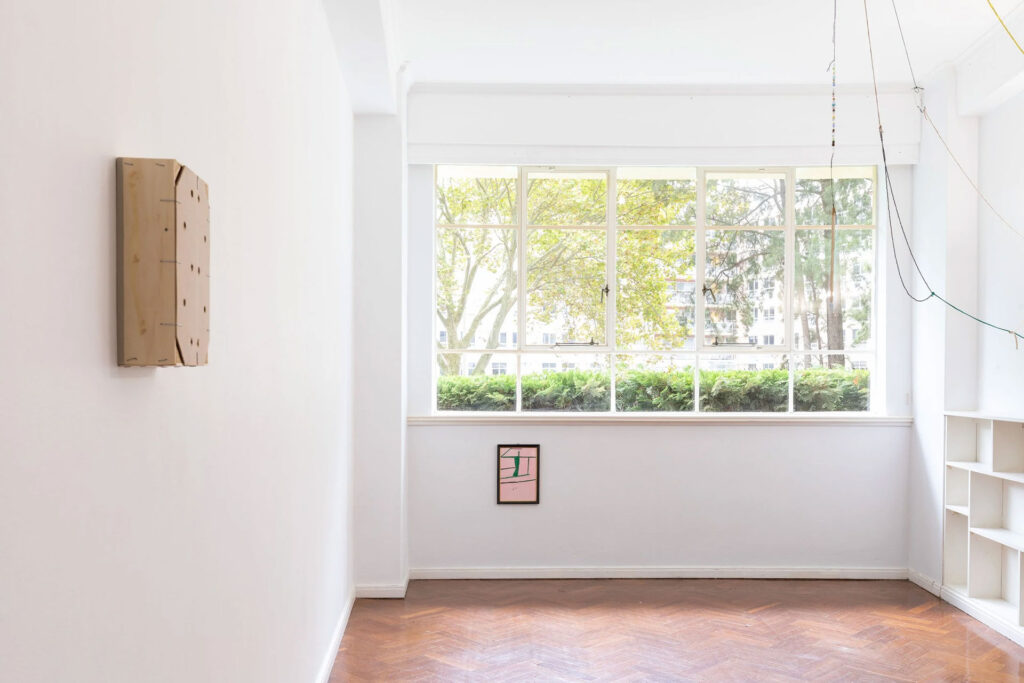
Conor O’Shea sits on the rooftop of his apartment building, the Sydney Harbour Bridge against blue skies visible as a slightly pixelated blur across the online video call – signal cutting out midway through the elevator ride up. His apartment doubles as SydneySydney, the gallery he established ten years prior. It has operated across various locations and iterations throughout the city, now settled at its new home in Potts Point.
Conor has built a career through meaningful relationships and deep engagement with fellow artists and gallerists both internationally and nationally. Viewing each exhibition as part of a larger whole, he approaches programming as a kind of family tree, drawing connections between contrasting and parallel practices, ideas, and generations.
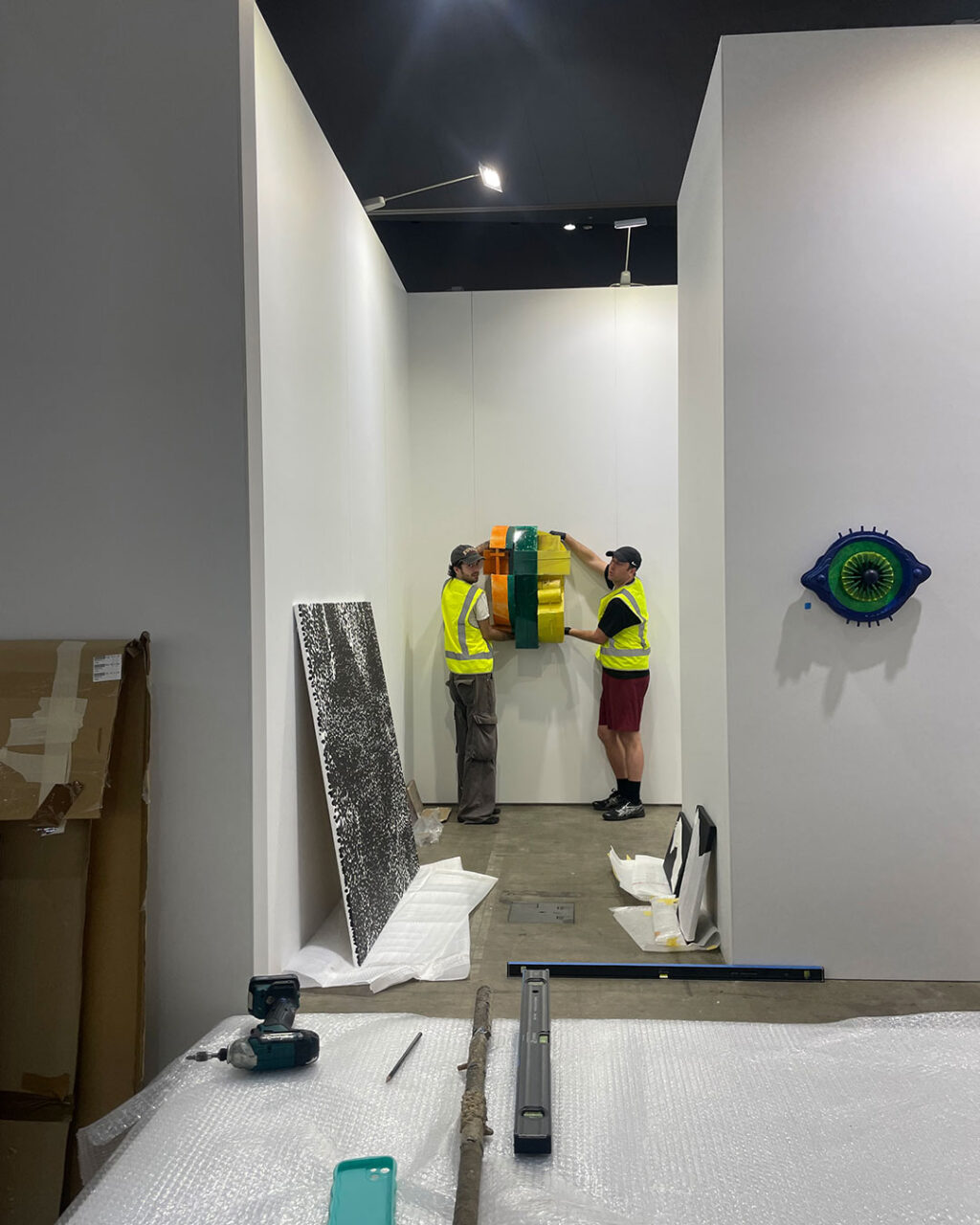
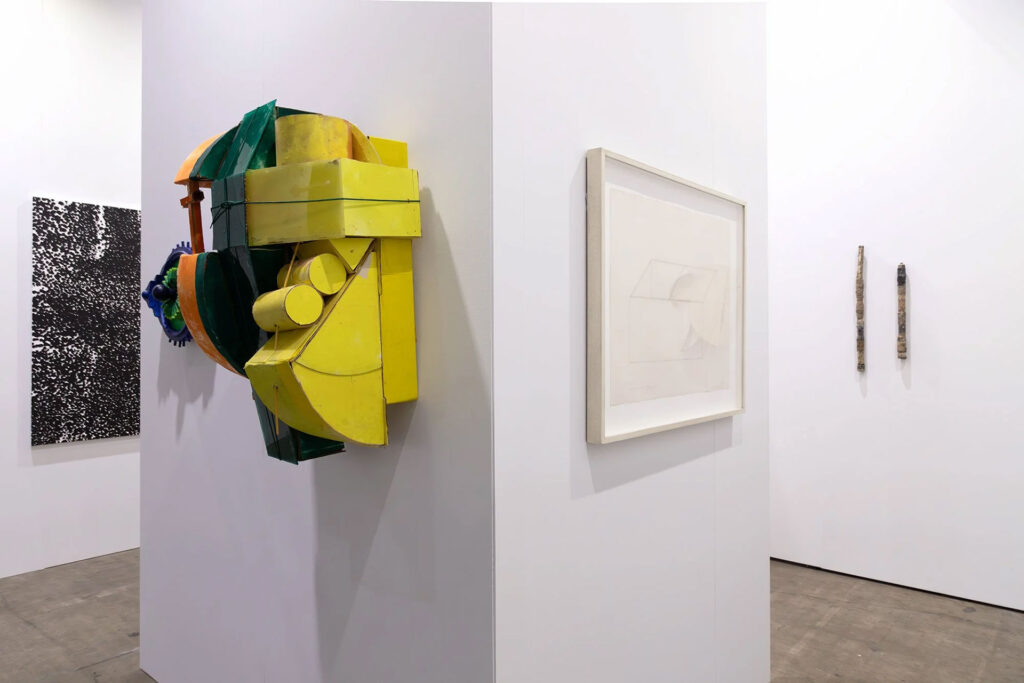
Earlier this year, he brought that approach to Melbourne Art Fair, presenting historical and contemporary practices with works by Donald Judd, J. Parker Valentine, Shiraz Sadikeen, Rose Nolan, Stephen Bram, Patrick Hartigan, Rudi Williams, Luke Brennan, Aden Miller, Bronte Stolz, Hilarie Mais and D&K.
Melbourne Art Fair speaks with Conor about how he builds his 24-month long exhibition programme, the intimacy between making and organising, and his experience exhibiting at the Fair for the first time earlier this year.
Can you tell us a bit about the gallery and your vision behind starting it?
I started the gallery ten years ago, so this year marks its tenth anniversary, which is pretty amazing. Initially it was a way to maintain a dialogue with friends living overseas by bringing their exhibitions to Sydney and contextualising their work alongside Australian artists. That remains the ethos of the gallery today. The core idea hasn’t really changed.
I’m also an artist, so after high school I went to art school. When I finished, I became really interested in organising exhibitions and creating spaces where people could come together and work collectively. Running a gallery grew naturally out of that.
The gallery operates from your apartment. How does that shape the way you work where the line between living and working becomes blurred?
I don’t see that as a problem. Personally, my favourite exhibition spaces are located in domestic spaces. If you visit galleries in Europe, they’re often housed in old apartment buildings that have been repurposed, and sometimes the gallerists live there as well.
For me, it’s not a radical gesture. It’s a practical way of working in an expensive city where having both a gallery and a separate home isn’t always possible. It’s aesthetically pleasing but also practically encouraging.
More importantly, I wanted to create a domestic scale for viewing art. When work is shown in a space that’s closer to how people actually live, it can be experienced at a more human scale. That intimacy is really important to me.
Looking back over the past decade, what have been some of the most significant milestones for the gallery?
I’ve been incredibly lucky to work with many of my favourite artists in the world.
One exhibition that stands out was with the Chicago-based sculptor Richard Rezac. He’s one of my favourite sculpture artists and an amazing human being. He created a work specifically for the gallery’s living room, which was very special.
I’ve also worked with Julia Fish, Louise Lawler, Gedi Sibony, and presented a really strange exhibition of Lawrence Weiner’s drawings made in Sydney in 1986. That exhibition took place in the bedroom of my previous space. But for me, the real milestones are the relationships. Building connections with artists and other gallerists over many years and continuing those conversations through exhibitions has been the most meaningful part of running the gallery.
Every exhibition feels significant because I’ve genuinely loved working with the people involved.
Your exhibition programme often brings together artists from very different contexts. How do you approach building it?
Usually, the programme is developed around two years in advance.
Sometimes, I write down the names of artists I’d like to work with on a piece of paper as solo exhibitions, and then thinking about how those exhibitions might relate to one another – if they would fit as a group exhibition. I tend to see the entire 24-month programme as one large group exhibition. Each solo exhibition relates to each other in different ways. There may be huge contrasts or unexpected parallels – maybe certain things relate to each other that would never usually meet each other.
Most of the time, it’s about meeting people, developing a relationship and developing an exhibition program from that. I think of it almost like a family tree that’s constantly evolving. I’m interested in finding connections between practices that might not appear related at first glance.
That approach probably comes from being an artist myself running the gallery. The relationship I have with artworks is very intimate, and the acts of making and organising feel closely connected. The exhibition programme becomes a way of bringing those similar energies together.
What motivated you to participate in Melbourne Art Fair this year, and can you tell us about your presentation?
Melissa [Loughnan, MAF’s Fair Director] contacted me, who’s fantastic, so of course I was excited to participate alongside lots of peers and contemporaries. There were amazing galleries involved.
For the booth, I had a Donald Judd work on paper from the 1960s, a Stephen Bram painting, Rose Nolan boxes, a J. Parker Valentine work on loose canvas, three works by Shiraz Sadikeen, work by Bronte Stolz, Rudy Williams, Luke Brennan, Aidan Miller, Patrick Hartigan, D.K., and Hilarie Mais, who is also my gallerist.
Again, it was like a group exhibition but a lot of the artists in the booth have had solo exhibitions with me. It went back to that way of working where you’re programming a 24-month experience and making a family-tree-style group exhibition – that was highlighted in the booth.
I wanted to make a real exhibition, not just a commercial art fair presentation.
How did people respond to the exhibition?
I had a lot of in-depth conversations with curators, which was lovely. I met new collectors, placed works in some great collections, and overall it was a lot of fun. It was very hard work, but in a good way. It was really dynamic.
One thing I was very happy about was that the work I showed felt completely authentic to my interests. There wasn’t a single work in the booth that was there simply because it might sell. Everything I included was something I genuinely believed in.
To have people respond positively to that was really meaningful to me. Some of the work was quite challenging, and seeing people engage with it, and even purchase it, was exciting.
It was great to see really established artists like Donald Judd and Rose Nolan presented alongside more emerging contemporary artists. Is that something you actively think about?
I think it’s pretty natural.
The Donald Judd work wasn’t a major sculpture worth millions of dollars – it was a work on paper. But it was made with pencil – it wasn’t a print. It was hand-drawn and connected to one of his most famous sculptures, a red cadmium box now held in a museum collection in America. Although it wasn’t physically one of his famous sculptures, it had his essence in it. I think that pairs well with artists making work currently because it holds something in it that’s quite intimate that can be related outward.
For example, I was listening to a podcast of an interview with Danh Vo recently, and he spoke about a work on paper he made with his father. He said that if he could leave behind only one work, or if he could only make one work, it would be that one work on paper – not the sculptures or any of his larger pieces.
I thought that was really interesting. A work doesn’t have to be large or monumental to connect with people deeply. That’s why the Judd drawing paired nicely with let’s say Shiraz’s work, who I really believe in as an artist. He also runs a gallery called Treadler. There are lots of parallels happening: artists running galleries, artists with shared interests. The booth became a way of highlighting those relationships.
As an artist yourself, do the exhibitions you present influence your own work?
Absolutely.
I’m incredibly lucky because I get to learn from all these people. Every exhibition teaches me something. I think the main part of it is building a community and encouraging other artists to run galleries too. It’s very nurturing for your own practice.
It’s also refreshing to take the focus away from yourself and your studio and instead invest your energy in other people whose work you believe in.
At the same time, it’s incredibly beneficial for your own work. It’s hard to explain, but there’s a lot of purpose in it.
There are artists I really admire who do this. Yvo Cho, in Cologne, runs Clementin Seedorf while maintaining his own practice. In Melbourne, Asbestos was run by artists Josh Krum, Aidan Miller and Brett d’Argaville. I think it’s a dynamic thing to do and it helps you figure out what you’re doing as an artist.
Can you tell us about your next exhibition with Stephen Bram?
I recently started representing Stephen in Sydney. The exhibition will feature one large painting and a series of smaller black-and-white paintings – very classic Stephen Bram.
There’s something about these paintings that’s really absurd in the best possible way. I saw them in the studio recently and although they’re quite small, they feel enormous.
It’s hard to describe. You almost enter the shapes and then can’t come out again. It’s a bit like looking at Google Maps and then it cuts out and suddenly you’ve lost your bearings.
Are there any other projects on the horizon?
I’ve got a very full program this year.
I’m working with Wyatt Niehaus, an American artist based in Amsterdam, who will be exhibiting here. He also ran a great gallery in Athens called Jacqueline.
There are a few other things I can’t announce just yet.
I’m also researching an exhibition by a significant Australian artist from the 1960s. We’re still working through some of the legalities, so I can’t say too much, but it’s going to be very exciting. I don’t think the work has been shown in Sydney before.
SydneySydney presents Stephen Bram, exhibiting 4 July – 15 August.
This site uses cookies to give you the best possible experience. By continuing to use the site you agree that we can save cookies on your device. Cookies are small text files placed on your device that remember your preferences and some details of your visit. Our cookies don’t collect personal information.