Kait James on Kiss My Moom, Tea Towels with a Sting, and the Weavers Who Shape Her Practice
Wadawurrung artist Kait James is known for her striking works that lure viewers in with quick wit and humour before revealing deeper, uncomfortable truths. Working across fabric collage, embroidery and rug-tufting techniques, she frequently incorporates pop culture references and Aboriginalia — racially stereotyped kitsch designs that have long circulated in the souvenir market for non-Indigenous consumers.
We spoke with Kait about her upcoming exhibition, Kiss My Moom, at Neon Parc, and why, should aliens ever arrive on Earth, she’d take them straight to her cousin Tammy Gilson.
How did you first find your way into textile art and what initially drew you to the medium?
Kait James: It was kind of a roundabout way, to be honest with you. I actually studied photography at university, but then didn’t take another photo once I graduated. It just wasn’t for me. I think I prefer making things with my hands.
I actually didn’t make any art for about 15 years before I started doing traditional weaving, which I was taught by my cousin, Tammy Gilson. From there, I began using colourful yarn to make work that was more in line with what I liked aesthetically.
At some point, the algorithm started sending me all these embroidery and punch-needling clips, and I was desperately wanting to try it. I think it’s the ability to make something with your hands. It’s the physical repetition that can be very satisfying, but also the colour and the combinations and the fabrics themselves.
I really wish I had studied textiles, or even printmaking, at uni. It’s taken me a long time to get there, but it’s definitely what I like to do.
In a way, it gives you a different perspective, not having that formal training. Have your previous photography studies informed your current practice?
KJ: Yeah, I think so — and my general interest in art as a whole. I still love photography, I’m just not a photographer.
It’s been an interesting process, and it does mean that I don’t necessarily do things the “right” way. I’m sure if someone saw the back of my embroidery works they’d be horrified. I don’t even use the punch needle the way it’s intended to be used.
But I think anyone can use a medium in whatever way suits them. That’s the fun way to do it.
Your works often draw people in with humour and wit before prompting deeper reflection, particularly around the uncomfortable truths of colonisation. The title of your upcoming exhibition, Kiss My Moom, feels both amusing and defiant. Can you expand on the title and the themes behind the exhibition?
KJ: “Moom” means “bum” in Kulin languages, including Wadawurrung. It’s cheeky and playful, but underneath there’s a clear message.
It was one of the first works I made for the show, and I thought it was an appropriate title to wrap all the themes together. I’ve been thinking a lot about how my work has changed since the referendum. It always had that undertone of drawing people in with colour and humour, but now the sting is closer to the surface. I want people to know exactly what I’m saying.
Most of my exhibition titles have had a similar kind of play on words, but this one really felt right. I want people to feel comfortable seeing the work, but I also want them to leave a little uncomfortable.
The show looks at colonial history and its ongoing impacts — particularly the way racism and power still operate today. There’s been a noticeable rise in very overt racism. Even recently I saw a young guy online saying they should bring back the White Australia policy. It’s disturbing.
So, in the show there’s a series of works where I’ve taken sayings that use the word “right” and changed it to “white”. For example, instead of “sounds about right”, it becomes “sounds about white”. Or instead of “right under your nose”, it becomes “white under your nose”.
There are a few different meanings layered into those works, but that’s something I’ve been exploring throughout the exhibition.
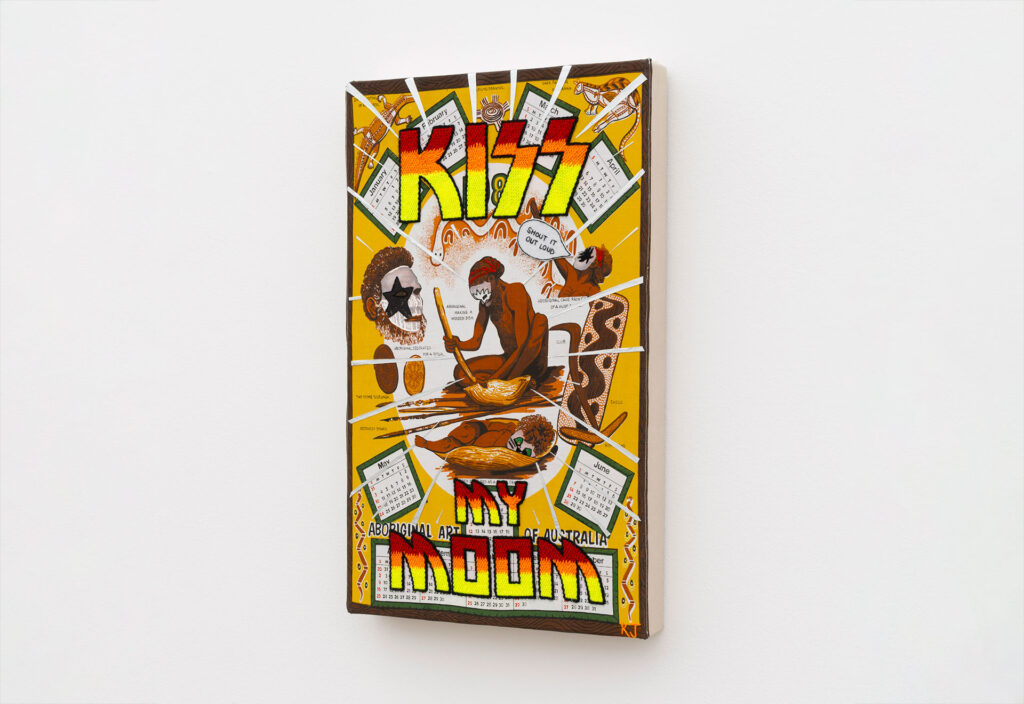
Kait James, Kiss My Moom, 2026, Yarn, cotton and metallic foil on printed cotton, 75 x 45.5 x 7 cm. Courtesy the artist and Neon Parc. Photo: Madé Spencer-Castle.
Much of your work incorporates Aboriginalia. How long have you been collecting these objects for? Do you remember the first piece that really stopped you in your tracks?
KJ: I’m not sure what the very first piece was, because you grow up kind of surrounded by this stuff. You still see it at markets and op shops. But I’ve been collecting them for over ten years now.
There’s a house near my mum and dad’s place that used to have concrete Aboriginal statues out the front. They always fascinated me. They’re actually really expensive now — thousands of dollars each because they’re rare. I used to wonder why they hadn’t been stolen, because they were probably worth more than the house they were sitting in front of. Eventually they did disappear.
I’m always curious about why people buy these things and keep them in their homes. I’ve looked a lot into Brownie Downing’s ceramics, drawings and books she made of Aboriginal babies and children. They were produced around the time of the Stolen Generations, and people would buy these figurines or wall decorations of Aboriginal children skipping with flowers. It seemed like a way of glazing over history and making themselves feel better.
That’s the part I’m really curious about. Why do people choose to have these objects in their homes? I collect them for different reasons, but the motivations behind them interest me a lot.
Some places won’t sell Aboriginalia anymore. The Mill Markets in Castlemaine stopped selling it, for example. But I’ve had people with stalls there reach out to me privately asking if I want to buy pieces “on the side”. It feels like there’s going to be a black market. Which is funny in itself — the idea of a black market for Black things.
The title work, Kiss My Moom, combines Aboriginalia with references to the 80s rock band KISS and their iconic makeup. Why did you choose to reference KISS specifically? And more broadly, how has music influenced your practice?
KJ: I wasn’t actually a huge fan of KISS, but I loved the whole idea of the glam and the makeup when I was a kid and not really thinking about what they were singing about. Some of the lyrics are a bit questionable.
But I thought it would be fun to use KISS as part of the play on words. We also had a KISS makeup set when I was a kid that I desperately wanted to play with. I can still picture it sitting under the bathroom cabinet in my childhood home.
So, it was really fun doing KISS-style makeup on some of the figures in the tea towels as well.
Music is a massive influence on my work, as is popular culture more broadly — especially from the 80s and 90s. I’ve used lyrics and song titles from people like David Bowie, Culture Club and the KLF.
When I go and see a band live it really triggers something in my brain. I’ll leave a concert with all these ideas for work. Sometimes they’re not even related to the music, but it sends my mind in a different direction creatively.
I love using popular culture in my work and that will definitely continue. In this exhibition there are also a couple of references to The Real Housewives.
Your practice spans fabric, collage, embroidery, rug-tufting and ceramics. Is there a technique you tend to return to most often?
KJ: Definitely punch-needling and embroidery. I like the repetition of it, and the fact that it’s portable. I was down at my parents’ place on the weekend making work on their couch.
Over the last couple of years I’ve been making quite large works, and there is one work in the show that’s about two metres — it’s a tablecloth. There are quite a few tablecloth works in this exhibition, which expand on my tea towel works in a different way.
Sometimes I think maybe I should move on from the tea towels, but I don’t want to. I’m happy to explore other mediums, but I think I’ll always come back to them. I see ideas in tea towels. If something ****** me off, I imagine it as a tea towel.
That’s where I feel comfortable expressing myself.
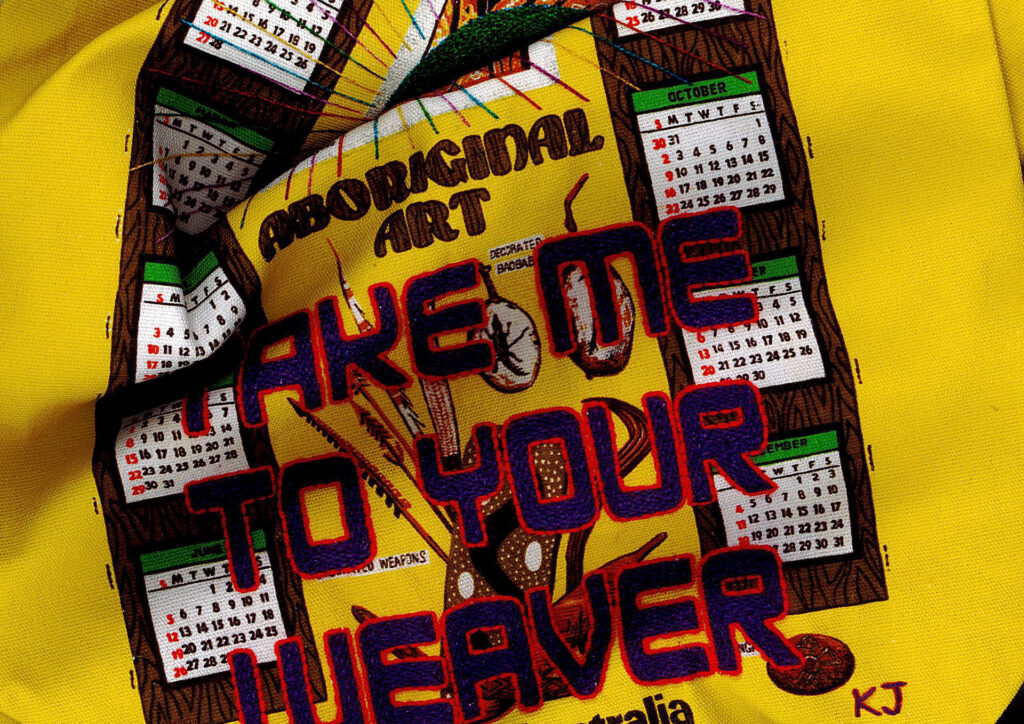
In your tea towel work Take Me to Your Weaver (2022)from The Blak Infinite, you mentioned that if an alien wanted to learn about Wadawurrung culture you would take them to your weaver, as they are the holders of cultural knowledge. How have the weavers around you influenced your practice?
That work really came from the experience of going to a workshop and weaving with cousins and aunties. That moment really shifted something for me and set me on a different trajectory.
Tammy Gilson, my cousin who taught me, is an incredible master weaver and holder of knowledge. If aliens came and wanted to learn about our culture, I’d take them straight to her.
Her sister, Deanne Gilson, has also been a huge influence. She’s been an artist for about forty years. And my Auntie Marlene as well — all of them have been really important influences on me wanting to make art.
It’s also about being surrounded by strong women. I come from a long line of strong women, and that idea of sitting together and weaving — that’s where so much knowledge sits.
So yes, if the aliens arrive, that’s where I’d take them.
Kait James x Third Drawer Down, Take Me To Your Weaver Tote, 2022.
Circling back to the Kiss My Moom — what lasting impression do you hope the exhibition leaves with viewers?
KJ: I don’t want people to feel guilt. That’s not the aim. But I do want people to feel unsettled and to think more deeply.
I like the idea of drawing people in and making them feel comfortable at first, and then making them feel unsettled. But, I don’t want the thinking to stop once they leave the gallery. I want people to keep thinking about the themes in the work and what’s happening in the world — and in Australia.
None of this is really fun and games. We can joke about things, otherwise we’d go insane, but at the end of the day it’s real life and it’s the reality we’re living in.
Kiss My Moom by Kait James, exhibiting at Neon Parc’s Brunswick location from 17 April to 16 May.
We acknowledge the Traditional Owners of the place now called Victoria, and all First Peoples living and working on this land. We recognise and celebrate the cultural heritage, creative contributions, and stories of the First Peoples of Victoria. We pay respect to Elders of today, emerging Elders of tomorrow and Elders of the past.
Important Cookie Information
This site uses cookies to give you the best possible experience. By continuing to use the site you agree that we can save cookies on your device. Cookies are small text files placed on your device that remember your preferences and some details of your visit. Our cookies don’t collect personal information.