Veteran of the Kiln, Vipoo Srivilasa On Creating Works That Radiate Joy
Vipoo Srivilasa has been in the ceramics game for years. Now a veteran of the kiln, the Thai-born Australian artist creates work that radiates joy.
His major exhibition, re/Joy, is currently touring the country, and is the largest body of work he has ever attempted. He chats with us at Melbourne Art Fair about the ideas behind the exhibition, the patience that ceramics demands, and his new Fortune Teller Deities for Melbourne Art Fair 2026.
Presented by Föenander Galleries, his work will feature alongside fellow artists Lottie Consalvo and Harry McAlpine.
How did you begin working in ceramics?
My first experience with ceramics was at the College of Fine Arts in Thailand. At the time, I was making fashion accessories such as necklaces and earrings using air-dry clay. The work became very popular, which made me a nice pocket money. That experience led me to choose ceramics as my major subject for both my graduate and master’s degrees.
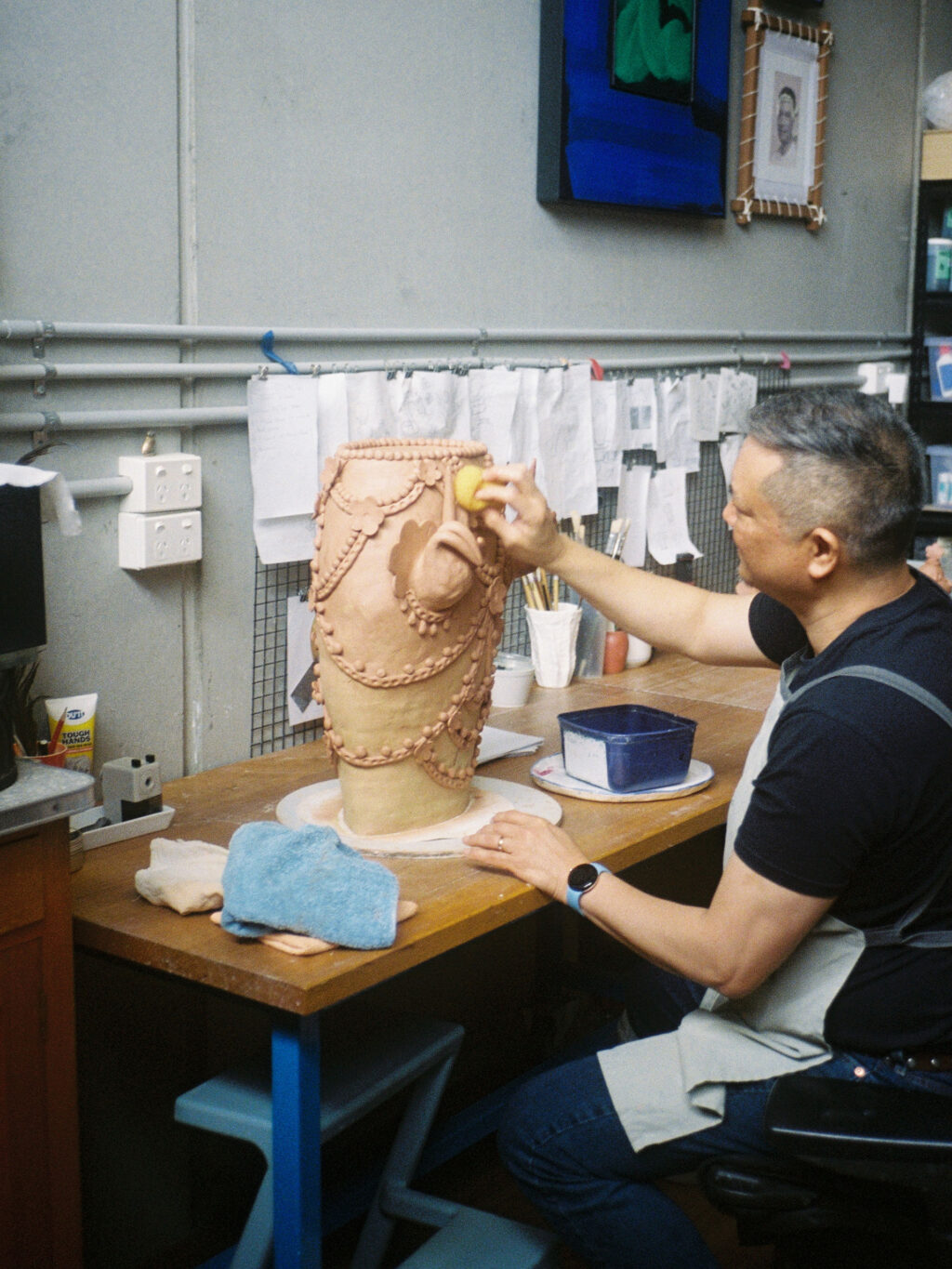
I love the touch of clay, it’s very tactile and, I think, quite sexy. I enjoy the transformation of a simple lump of clay into something expressive and full of character. Clay works naturally with my hands; somehow they just seem to know what to do. I’m also drawn to how versatile the material is, and to the excitement of opening a kiln. You never fully know what a piece will look like until it comes out.
Ceramics can be unpredictable in the kiln. Have any accidents or ‘failures’ ended up shaping the final work?
There are always accidents in ceramics. Sometimes they are happy accidents, but most of the time they are not. I try to see these moments as part of the learning process. Each mistake teaches me what not to do next time, so I don’t really think of them as failures.
That said, it can be difficult to stay positive when time is tight or a work has taken weeks to make. Ceramics demands patience and acceptance. Over time, I’ve learned that these unpredictable moments are part of what gives the medium its life and honesty.
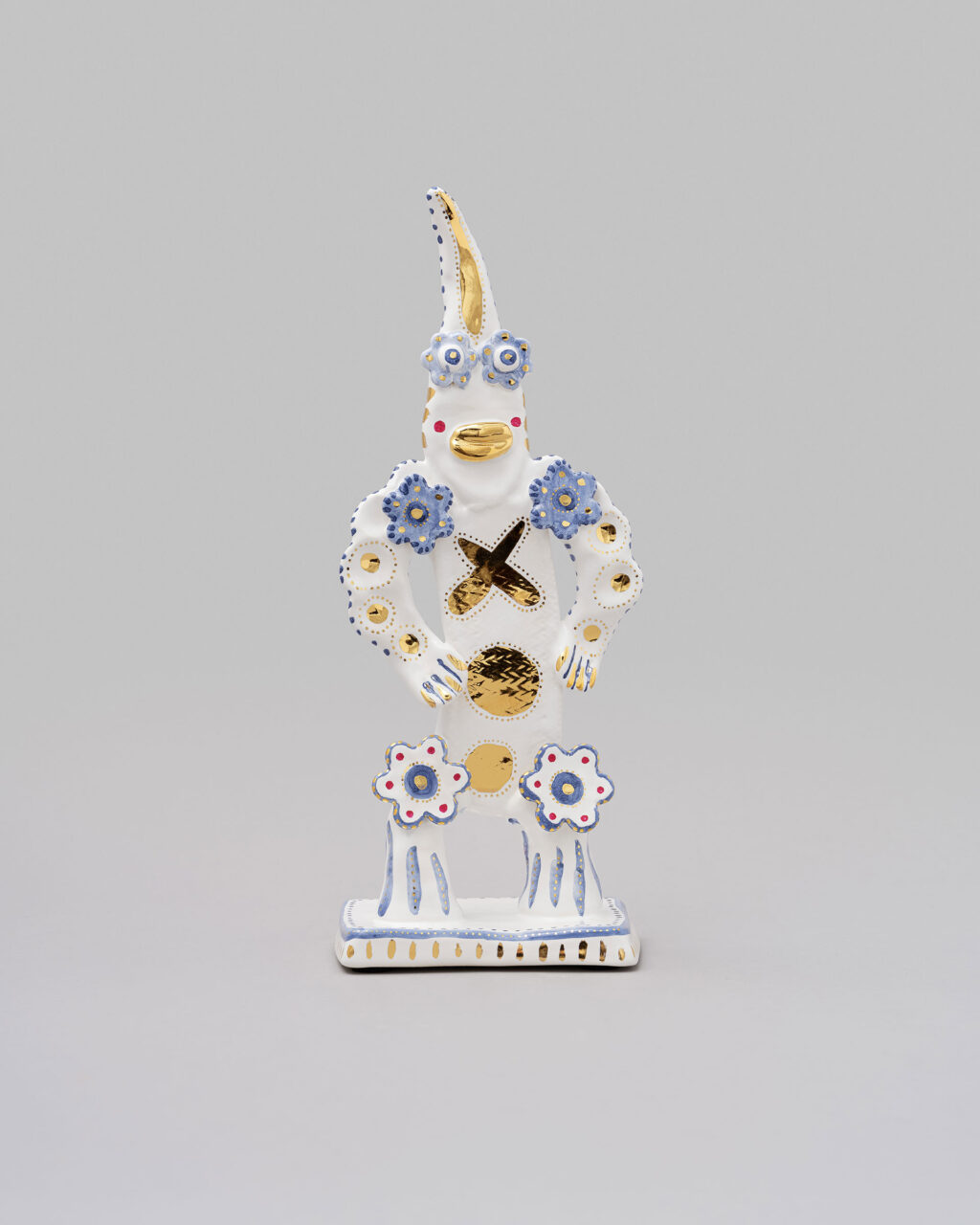
Vipoo Srivilasa, The Wish Listener, 2026, Glazed earthenware with gold lustre and synthetic polymer paint. 290 x 120 x 90mm.
Your exhibition, re/JOY, currently touring Australia, incorporates broken pieces from objects of personal significance. Can you expand on a couple of the objects you were donated and the stories behind them?
The objects donated for re/JOY came with very personal stories—items that were broken but still deeply loved. Most were everyday domestic objects that held memories of family, relationships, or particular moments in time. When these objects were broken, they became symbols of loss, change, or transition, but also of care and attachment.
By embedding these fragments into new ceramic sculptures, I wanted to honour both the object and the story behind it. The works become a way of transforming something damaged into something hopeful, allowing joy to re-emerge through repair, remembrance, and collective participation. But the main idea of re/JOY is to tell stories of migrations that may not be heard in the mainstream.
Photo courtesy the artist and Föenander Galleries.
The eighth sculpture draws on your grandmother’s button and your own migration story. Why was it important to include your personal narrative within this broader framework?
Originally, the project involved seven donated objects, but I realised I had time and space to make one more work. I decided to include my own story so I could experience the same emotional process as the participants.
Using my grandmother’s button allowed me to reflect on my own migration and personal history. It felt important to place myself within the project, not as an observer but as someone equally vulnerable. By asking myself the same questions I asked others, I gained a deeper understanding of what participants have experienced.
What’s an object you have, and might not need, but still can’t bring yourself to throw away?
The blue and white porcelain buttons that belonged to my grandmother. They are called Lai Kram, which means “blue and white pattern.” I believe this is why I am so drawn to blue and white ceramics. It has been part of my subconscious for as long as I can remember.
I brought the buttons with me to Australia because they are precious to me. They carry memories of my childhood and remind me of my roots and of my grandmother, who was very stylish. The buttons don’t form a complete set, and although I once tried to turn them into a necklace to wear, it didn’t quite work. Instead, I used them to create a necklace for one of my sculptures.
Ideally, I would love to one day find a complete set and use them as buttons on my shirt.
Do you have any rituals that help you get in the right mindset to work?
I usually go to the studio early in the morning and take my time planning what I want to do. Drinking sencha tea has become an important morning ritual for me. It’s a way of training my brain to recognise that creative work is about to begin.
By repeating this ritual every day, my body and mind ease naturally into work mode. When I feel blocked or uninspired, I return to tea-making. The more elaborate the process, the better. That’s probably why I’ve collected so many teapots, teacups, and different tea leaves over the years.
What will you be presenting at Melbourne Art Fair?
I will be presenting a series of ceramic figures titled Fortune Teller Deities. The works are created as quiet companions for everyday life. Each deity is named for a small but meaningful role: helping, listening, protecting, or encouraging, offering support not through prediction, but through presence.
Rather than foretelling the future, the figures acknowledge common human experiences such as uncertainty, hope, fatigue, longing, courage, and the desire for reassurance…in a very positive and fun way.
Vipoo Srivilasa, The Hope Keeper, 2026, Glazed earthenware with gold lustre and synthetic polymer paint. 240 x 150 x 90mm.
Looking to the future, are there any new ideas or themes you wish to explore in your work?
I love working with food and with people, and I hope to expand this further in future projects. I’ve already explored food-based works, but I’m also interested in developing projects around drinks. Ceramics can create beautiful vessels for drinks!
I’m particularly interested in the possibility of collaborating with people from other disciplines, such as mixologists. I think that combination could lead to exciting and meaningful outcomes.
Vipoo Srivilasa will be showing at Melbourne Art Fair 2026 with Föenander Galleries, Booth K2
We acknowledge the Traditional Owners of the place now called Victoria, and all First Peoples living and working on this land. We recognise and celebrate the cultural heritage, creative contributions, and stories of the First Peoples of Victoria. We pay respect to Elders of today, emerging Elders of tomorrow and Elders of the past.
Important Cookie Information
This site uses cookies to give you the best possible experience. By continuing to use the site you agree that we can save cookies on your device. Cookies are small text files placed on your device that remember your preferences and some details of your visit. Our cookies don’t collect personal information.